402.1
Purpose. The LCEP is to be prepared no later than the early part of the Technology Development phase and will aid in the development of the CONOPS, SRD, ICD, CDD, and the CPD. The LCEP, prepared by an environmental engineering specialist (combat/materiel developer staff or contractor), identifies and characterizes environments or combinations of environments to which the materiel could be exposed throughout its service life. Use the LCEP as the baseline document to support design and test activities throughout the materiel development process.
402.2
Task description. This is one of three tasks (Task 402, 403, and 404) that make up the Environmental Test and Evaluation Master Plan (ETEMP). The LCEP accurately describes real-world environmental conditions that are relevant to the materiel being developed. It provides a consistent baseline for design and test decisions regarding materiel performance and survival under realistically outlined operational environmental conditions. As such, it should not contain conservatism factors, parameter exaggeration, or test procedures that will be covered by other tasks. The LCEP is a living document that should be reviewed and updated periodically as new information regarding operational environmental conditions becomes available. A comparable NATO document, Allied Ordnance Publication 15 (AOP-15), “Guidance on the Assessment of Safety and Suitability for Service of Non-Nuclear Munitions for NATO Armed Forces” (1998), provides methodology to define specific details of the service environments, and to identify appropriate testing to demonstrate that munitions will perform acceptably under those conditions.
402.2.1
Contents of an LCEP. As a minimum, perform the following subtasks and include subtask products in the LCEP:
- a. Describe the anticipated logistical and operational events associated with the materiel from the time of final factory acceptance until the end of its useful life. Include description in the LCEP.
- b. Develop a list of significant natural and induced environments or combinations of environments associated with each of the events described in "a" above, and include the list in the LCEP.
- c. Prepare narrative, tabular, graphic, and statistical characterizations, to the extent practical, of the environmental stress conditions identified in "b" above. These characterizations may be a combination of analytical calculations, test results, and measurements on materiel systems in service. Include characterizations in LCEP.
402.2.2
Special considerations. When appropriate in developing the LCEP, describe the following special considerations along with any others that may apply, and include their descriptions in the LCEP:
- a. Anticipated materiel configuration (s) during manufacturing, handling, repair/rework, environmental stress screening (ESS), and transport.
- b. Environments to be encountered and their associated geographical and physical locations.
- c. Packaging/container designs/configurations.
- d. Platform on which the materiel is mounted, stored, or transported.
- e. Structural, operating, and other interfaces with adjacent materiel.
- f. Absolute and relative durations of exposure to environmental conditions in each life cycle phase, as well as any other circumstances of occurrence.
- g. Number of times each life cycle phase is expected to occur and its frequency or likelihood of occurrence.
- h. Anticipated limitations and critical values that the environment may have on the materiel because of materiel design or natural laws (e.g., fog or other precipitation may inhibit the effectiveness of infrared sensors).
402.3
Details to be provided by the acquisition agency. The LCEP must be the product of the shared knowledge of both the materiel supplier and the acquisition agency. The acquisition agency must provide, as a minimum:
- a. A thorough description of all anticipated logistical and operational events associated with the materiel from the time of final factory acceptance until its terminal expenditure, removal from the inventory, and demilitarization. Include:
- (1) Geographical areas of service or deployment.
- (2) Platforms on which the materiel will be mounted, stored, or transported.
- (3) Actual measurements of environmental conditions related to the same or similar materiel and platforms.
(4) Concept of Operation (CONOPS)
- b. Schedule and procedures for LCEP submittal.
- c. Identification as a contract task or submittal.
- d. Special conditions or restrictions.
402.4
Life Cycle Environmental Profile Questionnaire. To aid in the development of the CONOPS, SRD, ICD, CDD, and the CPD, the following questionnaire may be used to identify the planned environments and possible induced external influences during the in-service life of the materiel. The questionnaire is divided into eight sections, two main tables and six supplemental tables. Section 1 provides basic information about the materiel and should be used to identify the general purpose of the materiel. The response to the directions in sections 2 through 7 will be dependent upon the way the materiel will be stored, transported or serviced. This response can be filled out in Tables A and B. Some of the information in these tables will require more detailed information which can be filled out in tables C through H. The final question in section 8 is applicable any time. In the following questions, information should be provided if there is even a minimal chance of exposure to the respective environment. Annex C, Table C-II through C-IV contains a detailed list of environmental forcing functions an item may encounter throughout its storage, transportation, and deployment phase.
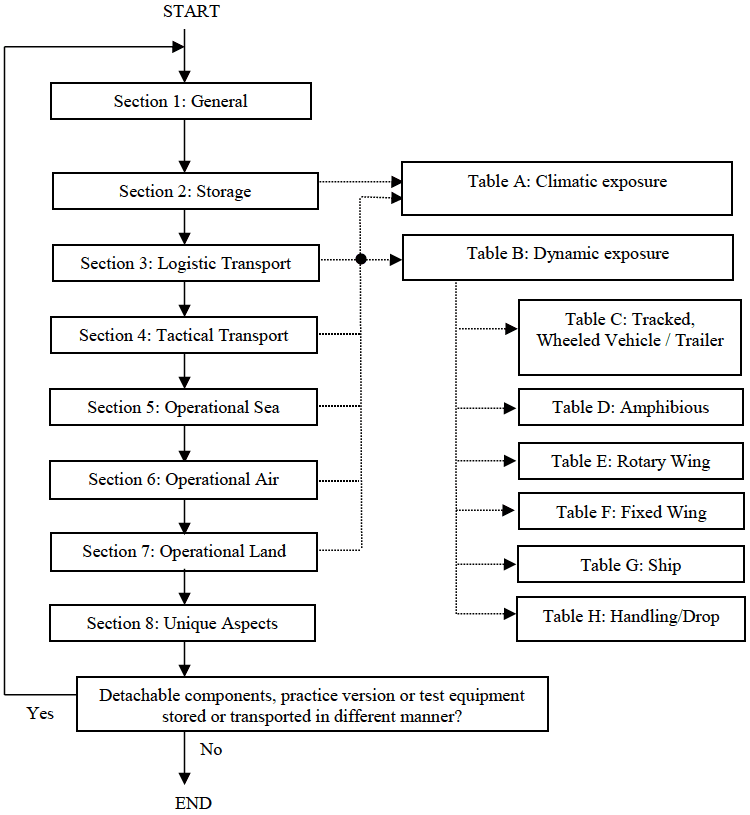
Figure description:
Life Cycle Environmental Profile Development Guide Flowchart
| Step / Decision | Action / Reference | Associated Data Tables |
|---|---|---|
| Start | Begin Process | - |
| Section 1 | General Information | - |
| Section 2 | Storage | Table A: Climatic exposure |
| Section 3 | Logistic Transport | Table A & Table B: Dynamic exposure |
| Section 4 | Tactical Transport | Table A & Table B |
| Section 5 | Operational Sea | Table A & Table B |
| Section 6 | Operational Air | Table A & Table B |
| Section 7 | Operational Land | Table A & Table B |
| Section 8 | Unique Aspects | - |
| Decision | Detachable components, practice version or test equipment stored or transported in different manner? | Yes: Return to Section 1 No: End |
Supplementary Dynamic Exposure Detail (Table B Extensions:
- Table C: Tracked, Wheeled Vehicle / Trailer
- Table D: Amphibious
- Table E: Rotary Wing
- Table F: Fixed Wing
- Table G: Ship
- Table H: Handling/Drop
Figure 402-1. Life Cycle Environmental Profile Development Guide
MIL-STD-810H
PART ONE ANNEX A
Section 1: General
| No. | Question | Response |
|---|---|---|
| 1.1 | State whether one of the following is applicable for the item: a. detachable components b. practice version available c. in service assembly d. necessary test equipment Will those parts / items be stored and transported separately and/or in a different manner? If so, fill out the questionnaire for each item or component separately. | |
| 1.2 | Which of the Services are likely to use this item? | |
| 1.3 | State whether the item will be operated from inside an enclosure? | Y/N |
| 1.4 | What is the intended total lifetime for this item (including disposal)? | |
| 1.5 | May the life be achieved by replacing short-life components during service? | Y/N |
| 1.6 | What will be done with items that exceed their service life? (see AECTP-600 for evaluating extended life requirements) | |
| 1.7 | If packaged, describe the packaging or protection intended for each of the following situations: | Specify: |
| a. storage | a. | |
| b. transit | b. | |
| c. during operation | c. | |
| d. any other purpose? Specify role. | d. | |
| 1.8 | Is the item or packaging required to be water tight or vapor tight? If yes, will a desiccant be used? | Y/N |
| 1.9 | Is the item required to be capable of functioning after exposure to an Electro Magnetic Pulse (exo- or endo-atmospheric)? | Y/N |
| 1.10 | Could the item be influenced by other surrounding equipment, like Electromagnetic field(s)? | Y/N |
Section 2: Storage
| No. | Direction | Completed by |
|---|---|---|
| 2.1 | Complete the storage column of Table A. Climatic zones are described in Part One, Annex C and Part Three of this standard. The storage column of Table A should be completed for all types of storage including storage associated with other phases of the life cycle. | Name: Date: |
MIL-STD-810H
PART ONE ANNEX A
Section 3: Logistic Transport
For this section it is assumed that the item is in its logistic packaging or configured for logistic transport. Logistic packaging is intended for transport of, mostly larger amounts of, items to or from the National storage locations. This packaging can vary in the degree of protection it provides for the packaged item, and may or may not contain sub packaging. For transport configuration it is possible that the item will be folded (down), disassembled or provided with a cover or protection.
If these instructions do not cover every situation, please go to the tactical transport section.
| No. | Direction | Completed by |
|---|---|---|
| 3.1 | Complete the Logistic Transport column of Table A. Although this requires durations, it may be sufficient to merely indicate the climatic category if these are not known. | Name: Date: |
| 3.2 | Complete the Logistic Transport column of Table B and the relevant supplemental tables. | Name: Date: |
Section 4: Tactical Transport
For this section it is assumed that the item is in its logistic or tactical packaging or configured for tactical transport. If these questions do not cover any situation, please go to operational sections.
Tactical packaging is intended for transport, over (multiple) shorter distance(s), just before or during operational use. This packaging, mostly, provides less protection than the logistical packaging.
| No. | Direction / Question | Response |
|---|---|---|
| 4.1 | Complete the Tactical Transport column of Table A. Although this requires durations, it may be sufficient to merely indicate the climatic category if these are not known. | Completed by |
| 4.2 | Complete the Tactical Transport column of Table B and the relevant supplemental tables. | Completed by |
| 4.3 | Will the item be transferred at sea horizontal (jackstay) replenishment and in what packaged state? | Y/N |
Section 5: Operational Sea
| No. | Direction | Completed by |
|---|---|---|
| 5.1 | Complete the Operational Sea column of Table A. | Name: Date: |
| 5.2 | Complete the Operational Sea column of Table B and the relevant supplemental tables. | Name: Date: |
MIL-STD-810H
PART ONE ANNEX A
Section 6: Operational Air
| No. | Direction | Completed by |
|---|---|---|
| 6.1 | Complete the Operational Air column of Table A. Indicate respective exposure in each climatic category for the following: a. standby (on the ground/flight deck) b. operating (carriage at altitude) | Name: Date: |
| 6.2 | Complete the Operational column of Table B and the relevant supplemental tables. | Name: Date: |
Section 7: Operational Land
| No. | Direction | Completed by |
|---|---|---|
| 7.1 | Complete the Operational Land column of Table A. Indicate respective exposure in each climatic category for the following: a. standby or installation b. operating or in use | Name: Date: |
| 7.2 | Complete the Operational column of Table B and the relevant supplemental tables. | Name: Date: |
Section 8: Unique Aspects
| No. | Question | Response |
|---|---|---|
| 8.1 | Is there any situation, condition or external influence which might be expected during the lifetime of the item which is not addressed in the questionnaire? | Detail: |
Table A: Climatic Exposure
| Environment | Climatic Zone | Duration¹ (Indicate the duration of expected exposure for each phase of the Life Cycle) | Other Information | ||||||||
|---|---|---|---|---|---|---|---|---|---|---|---|
| Storage² | Logistic Transport | Tactical Transport | Operational Sea | Operational Air | Operational Land | ||||||
| Standby | Operating | Standby | Operating | Standby | Operating | ||||||
| High Temperature | A1 | ||||||||||
| A2 | |||||||||||
| A3 | |||||||||||
| M1 | |||||||||||
| M2 | |||||||||||
| Low temperature | CO | ||||||||||
| C1 | |||||||||||
| C2 | |||||||||||
| C3 | |||||||||||
| C4 | |||||||||||
| M3 | |||||||||||
| Solar Radiation | A1 | ||||||||||
| A2 | |||||||||||
| A3 | |||||||||||
| M1 | |||||||||||
| M2 | |||||||||||
| Humidity | B1 | ||||||||||
| B2 | |||||||||||
| B3 | |||||||||||
| M1 | |||||||||||
| M2 | |||||||||||
MIL-STD-810H
PART ONE ANNEX A
Table A (Continued): Climatic Exposure
Requirement (indicate during which life cycle phase each environment may occur ) Environment: Storage: <empty> Logistic Transport Sea: <empty> Logistic Transport Air: <empty> Logistic Transport Land: <empty> Tactical Transport Sea: <empty> Tactical Transport Air: <empty> Tactical Transport Land: <empty> Operational Sea: <empty> Operational Air: <empty> Operational Land: <empty> Duration (if known): <empty> Other Information: <empty>
Thermal shock: Storage: <empty> Logistic Transport Sea: <empty> Logistic Transport Air: <empty> Logistic Transport Land: <empty> Tactical Transport Sea: <empty> Tactical Transport Air: <empty> Tactical Transport Land: <empty> Operational Sea: <empty> Operational Air: <empty> Operational Land: <empty> Duration (if known): <empty> Other Information: <empty>
Immersion: Storage: <empty> Logistic Transport Sea: <empty> Logistic Transport Air: <empty> Logistic Transport Land: <empty> Tactical Transport Sea: <empty> Tactical Transport Air: <empty> Tactical Transport Land: <empty> Operational Sea: <empty> Operational Air: <empty> Operational Land: <empty> Duration (if known): <empty> Other Information: <empty>
Fungal Growth: Storage: <empty> Logistic Transport Sea: <empty> Logistic Transport Air: <empty> Logistic Transport Land: <empty> Tactical Transport Sea: <empty> Tactical Transport Air: <empty> Tactical Transport Land: <empty> Operational Sea: <empty> Operational Air: <empty> Operational Land: <empty> Duration (if known): <empty> Other Information: <empty>
Salt Fog: Storage: <empty> Logistic Transport Sea: <empty> Logistic Transport Air: <empty> Logistic Transport Land: <empty> Tactical Transport Sea: <empty> Tactical Transport Air: <empty> Tactical Transport Land: <empty> Operational Sea: <empty> Operational Air: <empty> Operational Land: <empty> Duration (if known): <empty> Other Information: <empty>
Rain: Storage: <empty> Logistic Transport Sea: <empty> Logistic Transport Air: <empty> Logistic Transport Land: <empty> Tactical Transport Sea: <empty> Tactical Transport Air: <empty> Tactical Transport Land: <empty> Operational Sea: <empty> Operational Air: <empty> Operational Land: <empty> Duration (if known): <empty> Other Information: <empty>
Icing: Storage: <empty> Logistic Transport Sea: <empty> Logistic Transport Air: <empty> Logistic Transport Land: <empty> Tactical Transport Sea: <empty> Tactical Transport Air: <empty> Tactical Transport Land: <empty> Operational Sea: <empty> Operational Air: <empty> Operational Land: <empty> Duration (if known): <empty> Other Information: <empty>
Pressure (Altitude): Storage: <empty> Logistic Transport Sea: <empty> Logistic Transport Air: <empty> Logistic Transport Land: <empty> Tactical Transport Sea: <empty> Tactical Transport Air: <empty> Tactical Transport Land: <empty> Operational Sea: <empty> Operational Air: <empty> Operational Land: <empty> Duration (if known): <empty> Other Information: <empty>
Sand and Dust: Storage: <empty> Logistic Transport Sea: <empty> Logistic Transport Air: <empty> Logistic Transport Land: <empty> Tactical Transport Sea: <empty> Tactical Transport Air: <empty> Tactical Transport Land: <empty> Operational Sea: <empty> Operational Air: <empty> Operational Land: <empty> Duration (if known): <empty> Other Information: <empty>
Contamination by Fluids: Storage: <empty> Logistic Transport Sea: <empty> Logistic Transport Air: <empty> Logistic Transport Land: <empty> Tactical Transport Sea: <empty> Tactical Transport Air: <empty> Tactical Transport Land: <empty> Operational Sea: <empty> Operational Air: <empty> Operational Land: <empty> Duration (if known): <empty> Other Information: <empty>
Freeze/Thaw: Storage: <empty> Logistic Transport Sea: <empty> Logistic Transport Air: <empty> Logistic Transport Land: <empty> Tactical Transport Sea: <empty> Tactical Transport Air: <empty> Tactical Transport Land: <empty> Operational Sea: <empty> Operational Air: <empty> Operational Land: <empty> Duration (if known): <empty> Other Information: <empty>
MIL-STD-810H
PART ONE ANNEX A Table A (Continued): Climatic Exposure
Environment: Explosive Atmosphere Requirement (indicate during which life cycle phase each environment may occur ) Storage: <empty> Logistic Transport Sea: <empty> Air: <empty> Land: <empty> Tactical Transport Sea: <empty> Air: <empty> Land: <empty> Operational Sea: <empty> Air: <empty> Land: <empty> Duration (if known): <empty> Other Information: <empty>
Environment: Acidic Atmosphere Requirement (indicate during which life cycle phase each environment may occur ) Storage: <empty> Logistic Transport Sea: <empty> Air: <empty> Land: <empty> Tactical Transport Sea: <empty> Air: <empty> Land: <empty> Operational Sea: <empty> Air: <empty> Land: <empty> Duration (if known): <empty> Other Information: <empty>
Environment: Wind Requirement (indicate during which life cycle phase each environment may occur ) Storage: <empty> Logistic Transport Sea: <empty> Air: <empty> Land: <empty> Tactical Transport Sea: <empty> Air: <empty> Land: <empty> Operational Sea: <empty> Air: <empty> Land: <empty> Duration (if known): <empty> Other Information: <empty>
Environment: Green Sea Loading Requirement (indicate during which life cycle phase each environment may occur ) Storage: <empty> Logistic Transport Sea: <empty> Air: <empty> Land: <empty> Tactical Transport Sea: <empty> Air: <empty> Land: <empty> Operational Sea: <empty> Air: <empty> Land: <empty> Duration (if known): <empty> Other Information: <empty>
MIL-STD-810H PART ONE ANNEX A Table B : Dynamic Exposure
| Category | Mechanical environment | Table1 | Units | (Indicate the expected exposure for each phase of the Life Cycle) | Other Information / References2 | ||||
|---|---|---|---|---|---|---|---|---|---|
| Logistic Transport | Tactical Transport | Operational | Details | ||||||
| Vibration | Wheeled vehicle/ 4-wheeled trailer | C | (km) | ||||||
| Tracked vehicle | (km) | ||||||||
| 2-wheeled trailer | (km) | ||||||||
| Amphibious | D | (km) | |||||||
| Rotary wing | E | (hr) | |||||||
| Fixed wing | F | (hr) | |||||||
| Railroad | (km) | ||||||||
| Ship-board | G | (days) | |||||||
| Submarine | (days) | ||||||||
| Acoustic | Y/N? | Severe acoustic environment? (> 140 dB) | |||||||
| Other | (km) or (hr) | ||||||||
| Shock | Handling/Drop | H | Y | Y | Y | ||||
| Munition Launch | Y/N? | ||||||||
| Air delivery (parachute) | Number? | Packaged state? | |||||||
| Catapult Launch / Recovery | Y/N? | ||||||||
| Adjacent launch | (rounds) | Specify adjacent munition | |||||||
| Pyrotechnic | Y/N? | Specify near/far field | |||||||
| Gunfire | (rounds) | Specify gun | |||||||
| Ballistic | Y/N? | Survivability of indirect ballistic impact | |||||||
| Undex | Y/N? | Still safe and suitable? | |||||||
| Rail impact | Y/N? | ||||||||
| Acceleration | Constant | (g) | Max g? | ||||||
Note¹: Complete Tables for each type / variant identified.
Note²: Provide other information /references as relevant.
Table C : Tracked or wheeled vehicle / trailer
| Type/ Variant 1 | ||
|---|---|---|
| Terrain | On road | Off road |
| Logistic | ||
| Distance | ||
| Avg Speed | ||
| Max Speed | ||
| Tactical | ||
| Shock mounting | Y/N? | Y/N? |
| Secured cargo | Y/N/Both? | Y/N/Both? |
| Distance | ||
| Avg Speed | ||
| Max Speed | ||
| Operational | ||
| Shock mounting | Y/N? | Y/N? |
| Secured cargo | Y/N/Both? | Y/N/Both? |
| Distance | ||
| Avg Speed | ||
| Max Speed | ||
¹ To be filled out for each type/variant
Table D : Amphibious vehicle
| Type/ Variant1 | |||
| Terrain | Water2 | On-road | Off-road |
| Logistic | |||
| Distance | |||
| Avg Speed | |||
| Max Speed | |||
| Tactical | |||
| Shock mounting | Y / N? | Y / N? | Y / N? |
| Distance | |||
| Avg Speed | |||
| Max Speed | |||
| Operational | |||
| Shock mounting | Y / N? | Y / N? | Y / N? |
| Distance | |||
| Avg Speed | |||
| Max Speed | |||
¹ To be filled out for each type/variant
² Complete the water environment for sea and river/littoral if applicable.
MIL-STD-810H
PART ONE ANNEX A Table E : Rotary Wing
Type/ Variant¹: <empty> Logistic Duration internal [hrs]: <empty> Duration underslung [hrs]: <empty> Delivery at sea (vertical replenishment): Y / N, Specify sea state Tactical / Operational Duration once [hrs]: <empty> Duration cumulative [hrs]: <empty> Adjacent stores: Y / N, Specify adjacent stores Projected mission profile Number of take off's / landings: <empty> Cruise [% of operational duration]: <empty> Tactical Maneuver [% of operational duration]: <empty> Attack [% of operational duration]: <empty> Show of force [% of operational duration]: <empty>
To be filled out for each type/variant
Table F : Fixed Wing
Type/ Variant¹: <empty> Logistic Duration [hrs]: <empty> Tactical / Operational Duration once [hrs]: <empty> Duration cumulative [hrs]: <empty> Adjacent stores: Y/N, Specify adjacent stores Projected mission profile Number of take off's/landings: <empty> Cruise [% of operational duration]: <empty> Tactical Maneuver [% of operational duration]: <empty> Attack [% of operational duration]: <empty> Show of force [% of operational duration]: <empty>
To be filled out for each type/variant
Table G : Shipboard
| Duration [days] | |||
|---|---|---|---|
| Type/ Variant ¹ | Logistic | Tactical | Operational |
| Masthead | |||
| Exposed upper deck | |||
| On or adjacent to a flight deck or helicopter landing pad | |||
| On or near a designated vehicle park | |||
| Protected compartment | |||
| Hull, below water line | |||
¹ To be filled out for each type/variant
MIL-STD-810H
PART ONE ANNEX A Table H : Handling / Drop
| Handling / Drop category¹ | Logistic transport | Tactical transport/Operational | |||
|---|---|---|---|---|---|
| Packaged | Unpackaged | Packaged | Unpackaged | ||
| Ship transport | Y/N? | ||||
| Man carried | |||||
| Forklift | |||||
| Crane | |||||
| Vehicle (un)loading | |||||
| Bench handling | |||||
| Other | Specify: | ||||
¹ If known, state specific height for above environment.
MIL-STD-810H PART ONE ANNEX A
TASK 403
OPERATIONAL ENVIRONMENT DOCUMENTATION (OED)
403.1 Purpose. This is one of three tasks (Task 402, 403, and 404) completed by one or more environmental engineering specialists (combat/materiel developer staff or contractor) whose products comprise the Environmental Test and Evaluation Master Plan (ETEMP). To develop the Environmental Issues/Criteria List called for in Task 404, it may be necessary to obtain specific data that describe the environmental conditions laid out in the Life Cycle Environmental Profile established through Task 402. These data, the OED, are produced by preparing a plan and a report: the Operational Environment Documentation Plan (OEDP), to obtain data that will serve as the basis for design and test criteria development; and the Operational Environment Documentation Report (OEDR), that contains the OEDP and the data called for in that plan.
403.2 OEDP subtask description. The Operational Environment Documentation Plan (OEDP) provides for two types of data. First, it contains plans for obtaining data that already exist and are valid for developing the materiel design and test criteria. Second, it contains plans for collecting data not available currently, describing how to obtain those environmental data under realistic operating or field conditions using actual or closely related systems/platforms. As a minimum, perform the following subtasks and include subtask products in the OEDP:
403.2.1 Obtain available field/fleet data. Prepare a list of field/fleet data descriptions of materiel or platform environment conditions that can be used to develop environmental issues and criteria. Include the list in the OEDP. Adhere to all of the following guidelines:
- a. Materiel similarity. Whenever practical, obtain data on the same type of materiel on the same platform type that will carry the materiel to be tested. This ideal situation is often unattainable early in the development of new materiel. Therefore, it is sometimes necessary to derive data from appropriately similar materiel or carrying platforms. Under such circumstances, exact equivalence would not be expected nor required. It is important to note that materiel may be functionally dissimilar but still be considered comparable for documenting environmental stress conditions.
- b. Data quality. Satisfy the following minimum standards before considering field data suitable for use as criterion values in laboratory test procedures. Obtain, analyze, and format field data to be compatible with the specific test procedure for which those data are being considered as criteria. Include the following supporting information:
- (1) A description of the materiel or the carrying platform.
- (2) The location on the materiel or carrying platform at which the measurements were made.
- (3) The ambient environmental and operating conditions under which the measurements were made.
- (4) The type and calibration status of data recording and analysis equipment and instrumentation.
- c. Data quantity. Sufficient and traceable data are needed to adequately describe the conditions being evaluated, but the definition of sufficiency will vary with the environmental conditions, physical and performance characteristics of the hardware type, and program needs. Some engineering judgment may be required to assess the applicability of data when constraints limit the number and location of measurement points. As a minimum, consider:
- (1) The number and nature of data points.
- (2) The number and scope of test trials.
403.2.2 Develop plans for new data. When field/fleet data are not available (in data bases or other data sources) to describe specific environmental conditions, develop plans to acquire these needed data under actual service conditions. Prepare a list of new data requirements that can be used to develop environmental issues and criteria. Prepare plans for obtaining these new data. Include the list and the plans in the OEDP. In addition to following the guidelines and providing the information required in 403.2.1, above, for available data, include the following in the OEDP:
- a. A description of precisely what data are to be collected and to what degrees of accuracy.
- b. A description of the materiel locations at which measurements are to be made.
- c. Identify the instrumentation to be used to make these measurements.
- d. Provide mission profile time histories, durations, and the number of tests for which environmental measurements are to be made.
- e. Describe the assets and personnel to be provided by the procuring activity to obtain the required data, including vehicles, facilities, and information collection and processing equipment.
PART ONE-A-15
MIL-STD-810H
PART ONE ANNEX A
- f. Provide schedules for acquiring data.
- g. Identify the geographic locations at which measurements are to be made.
- h. Identify points of contact and lines of communication between the procuring activity and the contractor environmental engineering organizations.