This Standard contains materiel acquisition program planning and engineering direction for considering the influences that environmental stresses have on materiel throughout all phases of its service life. It is important to note that this document does not impose design or test specifications. Rather, it describes the environmental tailoring process that results in realistic materiel designs and test methods based on materiel system performance requirements. Figure 1-1 summarizes this direction.
- NOTE 1: COMPLETE TASK DESCRIPTIONS ARE IN APPENDIX A.
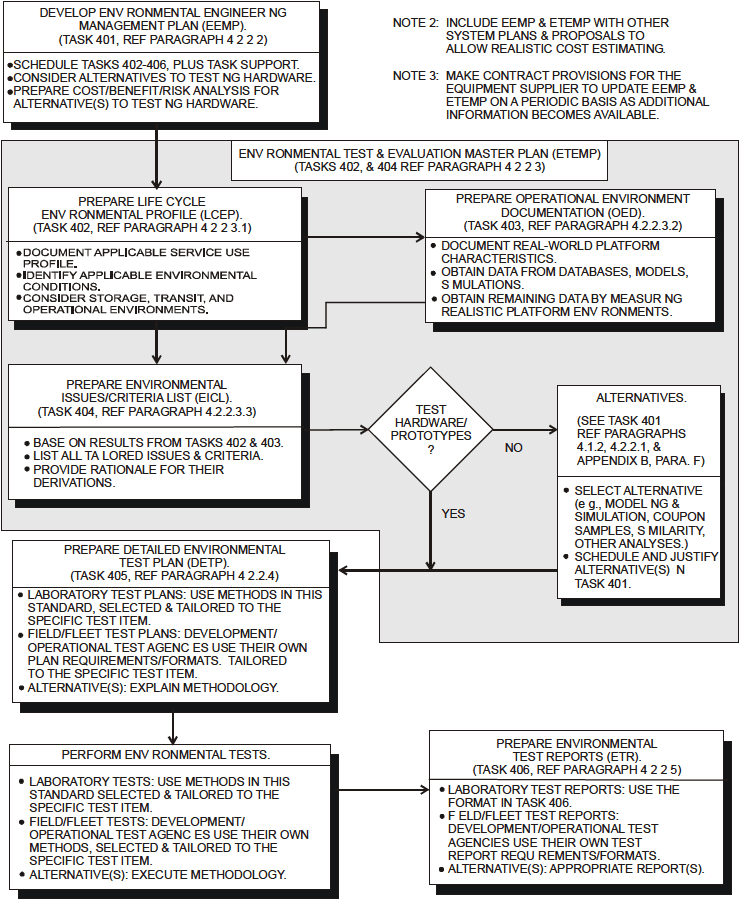
Figure description:
Environmental Engineering Program Guide (Figure 1-1
Key Process Steps:
- Develop Environmental Engineering Management Plan (EEMP (Task 401: Includes scheduling tasks 402-406, considering hardware testing alternatives, and performing cost/benefit/risk analyses.
- Environmental Test & Evaluation Master Plan (ETEMP (Tasks 402, 404: Overarching plan containing LCEP, OED, and EICL.
- Prepare Life Cycle Environmental Profile (LCEP (Task 402: Documents service use profiles and identifies environmental conditions (storage, transit, operational.
- Prepare Operational Environment Documentation (OED (Task 403: Documents platform characteristics using databases, models, simulations, or field measurements.
- Prepare Environmental Issues/Criteria List (EICL (Task 404: Derives tailored criteria and rationale based on LCEP and OED results.
- Decision: Test Hardware/Prototypes?
- No: Follow Alternatives (Task 401 such as modeling, simulation, or coupon samples; schedule and justify these alternatives.
- Yes: Proceed to Detailed Environmental Test Plan (DETP.
- Prepare Detailed Environmental Test Plan (DETP (Task 405: Defines specific methodologies for laboratory, field/fleet, or alternative testing.
- Perform Environmental Tests: Execution of laboratory, field, fleet, or alternative test methodologies.
- Prepare Environmental Test Reports (ETR (Task 406: Final documentation using standardized formats for all test types.
Important Notes:
- Note 2: EEMP and ETEMP must be included with other system proposals for realistic cost estimation.
- Note 3: Contracts should provide for periodic updates to the EEMP and ETEMP as new information becomes available.
Figure 1-1. Environmental engineering program guide.
This document supports the functions of three different groups of personnel involved in the materiel acquisition process. Each of these groups is critical to the goal of successfully incorporating environmental considerations into
materiel design, test, and evaluation. Although each group has different tasks to perform, none of these tasks can be isolated from the others in a successful acquisition program. As shown on Figure 1-2, this information is intended for the following:
- a. Materiel acquisition Program Managers among whose responsibilities is ensuring materiel will function as required in intended operational environments. (See 4.1, below.)
- b. Environmental engineering specialists (EES) who assist the capability and materiel developers throughout the acquisition process to tailor their materiel designs and test designs to environmental stresses/constraints expected during the materiel's service life. (See 4.2, below.)
- c. Design, test, and evaluation community analysts, engineers, and facility operators who meet user needs by focusing on tailored designs and tests. (See 4.3, below, and Part Two of this Standard.)
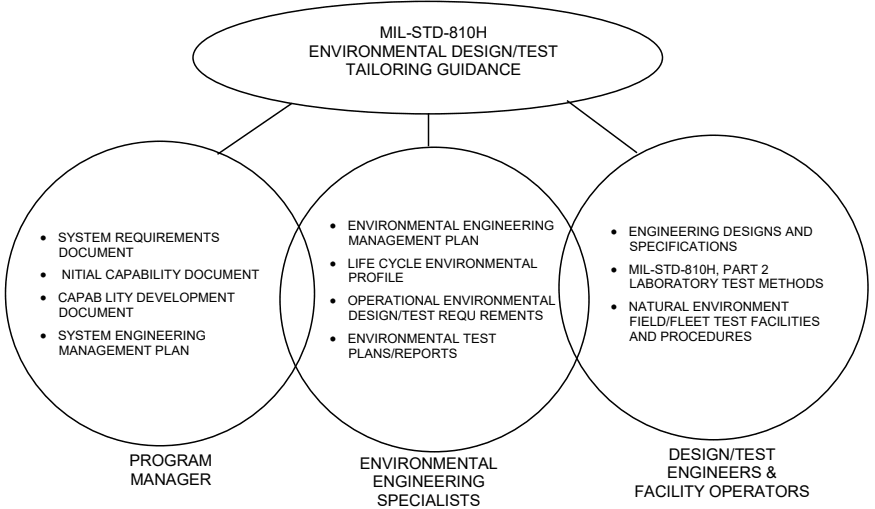
Figure description:
| Role / Category | Associated Documents and Responsibilities |
|---|---|
| Top-Level Guidance | MIL-STD-810H Environmental Design/Test Tailoring Guidance |
| Program Manager | • System Requirements Document • Initial Capability Document • Capability Development Document • System Engineering Management Plan |
| Environmental Engineering Specialists | • Environmental Engineering Management Plan • Life Cycle Environmental Profile • Operational Environmental Design/Test Requirements • Environmental Test Plans/Reports |
| Design/Test Engineers & Facility Operators | • Engineering Designs and Specifications • MIL-STD-810H, Part 2 Laboratory Test Methods • Natural Environment Field/Fleet Test Facilities and Procedures |
Figure 1-2. Roles of acquisition personnel in the environmental design/test tailoring process.