6.3.0
GENERAL COMMENTS — Nickel is the base element for most of the higher temperature heat-resistant alloys. While it is more expensive than iron, nickel provides an austenitic structure that has greater toughness and workability than ferritic structures of the same strength level.
6.3.0.1 Metallurgical Considerations
Composition — The common alloying elements for nickel are cobalt, iron, chromium, molybdenum, titanium, and aluminum. Cobalt, when substituted for a portion of the nickel in the matrix, improves high-temperature strength; small additions of iron tend to strengthen the nickel matrix and reduce the cost; chromium is added to increase strength and oxidation resistance at very high temperatures; molybdenum contributes to solid solution strengthening. Titanium and aluminum are added to most nickel-base heat resistant alloys to permit age-hardening by the formation of precipitates; aluminum also contributes to oxidation resistance.
The nature of the alloying elements in the age-hardenable nickel-base alloys makes vacuum melting of these alloys advisable, if not mandatory. However, the additional cost of vacuum melting is more than compensated for by the resulting improvements in elevated-temperature properties.
Heat Treatment — The nickel-base alloys are heat treated with conventional equipment and fixtures such as would be used with austenitic stainless steels. Since nickel-base alloys are more susceptible to sulfur embrittlement than are iron-base alloys, it is essential that sulfur-bearing materials such as grease, oil, cutting lubricants, marking paints, etc., be removed before heat treatment. Mechanical cleaning, such as wire brushing, is not adequate and if used should be followed by washing with a suitable solvent or by vapor degreasing. A low-sulfur content furnace atmosphere should be used. Good furnace control with respect to time and temperature is desirable since overheating some of the alloys as little as 35 °F impairs strength and corrosion resistance.
When it is necessary to anneal the age-hardenable-type alloys, a protective atmosphere (such as argon) lessens the possibility of surface contaminations or depletion of the precipitation-hardening elements. This precaution is not so critical in heavier sections since the oxidized surface layer is a smaller percentage of the cross section. After solution annealing, the alloys are generally quenched in water. Heavy sections may require air cooling to avoid cracking from thermal stresses.
In stress-relief annealing of a structure or assembly composed of an aluminum-titanium hardened alloy, it is vitally important to heat the structure rapidly through the age-hardening temperature range, 1200 °F to 1400 °F (which is also the low ductility range) so that stress relief can be achieved before any aging takes place. Parts which are to be used in the fully heat-treated condition would have to be solution treated, air cooled, and subsequently aged. In this case, the stress-relief treatment would be conducted in the solution-temperature range. Little difficulty has been encountered with distortion under rapid heating conditions, and distortion of weldments of substantial size has been less than that observed with conventional slow heating methods.
6.3.0.2 Manufacturing Considerations
Forging — All of the alloys considered, except for the casting compositions, can be forged to some degree. The matrix-strengthened alloys can be forged with proper consideration of cooling rates, atmosphere, etc. Most of the precipitation-hardenable grades can be forged, although heavier equipment is required and a smaller range of reductions can be safely attained.
MIL-HDBK-5J
6.3.1 HASTELLOY X
6.3.1.0
Comments and Properties — Hastelloy X is a nickel-base alloy used for combustor-liner parts, turbine-exhaust weldments, afterburner parts, and other parts requiring oxidation resistance and moderately high strength above 1450°F. It is not hardenable except by cold working and is used in the solution-treated (annealed) condition. Hastelloy X is available in all the usual mill forms.
Hastelloy X is somewhat difficult to forge; forging should be started at 2150 °F to 2200 °F and continued as long as the material flows freely. It should be in the annealed condition for optimum cold forming, and severely formed detail parts should be solution treated at 2150 °F for 7 to 10 minutes and cooled rapidly after forming. Machinability of Hastelloy X is similar to that of austenitic stainless steel; the alloy is tough and requires low cutting speeds and ample cutting fluids. Hastelloy X can be resistance or fusion welded or brazed; large or complex fusion weldments require stress relief at 1600 °F for 1 hour. Hastelloy X has good oxidation resistance up to 2100 °F. It age hardens somewhat during long exposure between 1200 °F and 1800 °F.
Some material specifications for Hastelloy X are presented in Table 6.3.1.0(a). Room-temperature mechanical and physical properties for Hastelloy X sheet are presented in Table 6.3.1.0(b). AMS 5754 does not specify tensile properties for bars and forgings. Figure 6.3.1.0 shows the effect of temperature on physical properties.
| Specification | Form | Condition |
|---|---|---|
| AMS 5536 | Sheet and plate | Solution heat treated (annealed) |
| AMS 5754 | Bar and forging | Solution heat treated (annealed) |
6.3.1.1
Annealed Condition — The effect of temperature on various mechanical properties is presented in Figures 6.3.1.1.1 and 6.3.1.1.4. In addition, certain stress-rupture requirements at 1500°F are specified in AMS 5536 and 5754 for Hastelloy X. Typical tensile stress-strain curves at room and elevated temperatures are presented in Figure 6.3.1.1.6(a). Typical compressive stress-strain and tangent-modulus curves at room and elevated temperatures are presented in Figure 6.3.1.1.6(b).
MIL-HDBK-5J
6.3.2 INCONEL 600
6.3.2.0
Comments and Properties—Inconel 600 is a corrosion- and heat-resistant nickel-base alloy used for low-stressed parts operating up to 2000°F. It is not hardenable except by cold working and is usually used in the annealed condition. Inconel 600 is available in all the usual mill forms.
Inconel 600 is readily forged between 1900 °F and 2250 °F; "hot-cold" working between 1200 °F and 1600 °F is harmful and should be avoided; cold working below 1200 °F results in improved properties. This alloy is readily formed but should be annealed after severe forming operations. The maximum annealing temperature is 1800 °F if minimum yield-strength requirements are to be met consistently. Inconel 600 is susceptible to rapid grain growth at 1800 °F or higher, and exposures at these temperatures should be brief if large grain size is objectionable.
Inconel 600 is somewhat difficult to machine because of its toughness and capacity for work hardening; high-speed steel or cemented-carbide tools should be used, and tools should be kept sharp. This alloy can be resistance or fusion welded or brazed (using nonsilver containing brazing alloy); large or complex fusion weldments should be stress relieved at 1600 °F for 1 hour. Oxidation resistance of Inconel 600 is excellent up to 2000 °F in sulfur-free atmospheres. This alloy is subject to attack in sulfur-containing atmospheres.
| Specification | Form | Condition |
|---|---|---|
| AMS 5540 | Plate, sheet, and strip | Annealed |
| ASTM B166 | Bar and rod | Various |
| AMS 5580 | Tubing, seamless | Annealed |
| ASTM B564 | Forging | Annealed |
Some material specifications for Inconel 600 are presented in Table 6.3.2.0(a). Room-temperature mechanical and physical properties are shown in Tables 6.3.2.0(b), (c), and (d). Figure 6.3.2.0 shows the effect of temperature on the physical properties.
6.3.2.1
Annealed Condition — Elevated-temperature data for this condition are shown in Figures 6.3.2.1.1 through 6.3.2.1.4.
MIL-HDBK-5J
31 January 2003
| Specification | AMS 5540 | AMS 5580 | ASTM B564 | |
|---|---|---|---|---|
| Form | Sheet, strip, and plate | Tubing | Forging | |
| Condition | Annealed | Cold drawn | Annealed | |
| Thickness, in. | 0.020-2.000 | |||
| Outside Diameter, in. | <5.000 | 5.001- 6.625 | ||
| Basis | S | S | S | S |
| Mechanical Properties: | ||||
| Ftu ksi: | ||||
| L | 80 | 80 | 80 | |
| LT | 80 | |||
| Fty, ksi: | ||||
| L | 35 | 30 | 35 | |
| LT | 35 | |||
| Fcy, ksi: | ||||
| L | 35 | 30 | 35 | |
| LT | 35 | |||
| Fsu, ksi | 51 | 51 | 51 | 51 |
| Fbru, ksi: | ||||
| (e/D = 1.5) | ||||
| (e/D = 2.0) | 152 | 152 | 152 | 152 |
| Fbry, ksi: | ||||
| (e/D = 1.5) | ||||
| (e/D = 2.0) | ||||
| e, percent: | ||||
| L | 30 | 35 | 30 | |
| LT | 30 | |||
| E, 103 ksi | 30.0 | |||
| Ec, 103 ksi | 30.0 | |||
| G, 103 ksi | 11.0 | |||
| μ | 0.29 | |||
| Physical Properties: | ||||
| ω, lb/in.3 | 0.304 | |||
| C, K, and α | See Figure 6.3.2.0 | |||
MIL-HDBK-5J
31 January 2003
| Specification | ASTM B166 | ||||
|---|---|---|---|---|---|
| Form | Round | Square, hexagon, and rectangle | |||
| Condition | Cold-worked | ||||
| Thickness, in | ≤0.499 | 0.500-1.000 | 1.001-2.500 | ≤0.250 | 0.251-0.499 |
| Basis | S | S | S | S | S |
| Mechanical Propertiesa: | |||||
| Ftu, ksi: | |||||
| L | 120 | 110 | 105 | 100 | 95 |
| LT | |||||
| Fy, ksi: | |||||
| L | 90 | 85 | 80 | 80 | 70 |
| LT | |||||
| Fcy, ksi: | |||||
| L | |||||
| LT | |||||
| Fsu, ksi | |||||
| Fbru, ksi: | |||||
| (e/D = 1.5) | |||||
| (e/D = 2.0) | |||||
| Fbry, ksi: | |||||
| (e/D = 1.5) | |||||
| (e/D = 2.0) | |||||
| e, percent: | |||||
| L | 7b | 10 | 12 | 5b | 7 |
| E, 103 ksi | 30.0 | ||||
| Ec, 103 ksi | 30.0 | ||||
| G, 103 ksi | 11.0 | ||||
| μ | 0.29 | ||||
| Physical Properties: | |||||
| ω, lb/in.3 | 0.304 | ||||
| C, K, and α | See Figure 6.3.2.0 | ||||
MIL-HDBK-5J
31 January 2003
| Specification | ASTM B166 | ||||
|---|---|---|---|---|---|
| Form | Round | Square, hexagon, and rectangle | Bar and rod | ||
| Condition | Hot-worked | Annealed | |||
| Thickness, in. | 0.250-0.500 | 0.501-3.000 | >3.000 | All | All |
| Basis | S | S | S | S | S |
| Mechanical Propertiesa: | |||||
| Ftu, ksi: | |||||
| L | 95 | 90 | 85 | 85 | 80 |
| LT | … | … | … | … | … |
| Fty, ksi: | |||||
| L | 45 | 40 | 35 | 35 | 35 |
| LT | … | … | … | … | … |
| Fcy, ksi: | |||||
| L | … | … | … | … | 35 |
| LT | … | … | … | … | … |
| Fsu, ksi | … | … | … | … | 51 |
| Fbru, ksi: | |||||
| (e/D = 1.5) | … | … | … | … | … |
| (e/D = 2.0) | … | … | … | … | 152 |
| Fbry, ksi: | |||||
| (e/D = 1.5) | … | … | … | … | … |
| (e/D = 2.0) | … | … | … | … | … |
| e, percent: | |||||
| L | 20 | 25 | 30 | … | 30b |
| E, 103 ksi | 30.0 | ||||
| Ec, 103 ksi | 30.0 | ||||
| G, 103 ksi | 11.0 | ||||
| μ | 0.29 | ||||
| Physical Properties: | |||||
| ω, lb/in.3 | 0.304 | ||||
| C, K, and α | See Figure 6.3.2.0 | ||||
MIL-HDBK-5J
6.3.3 INCONEL 625
6.3.3.0
Comments and Properties — Inconel 625 is a solid-solution, matrix strengthened nickel-base alloy primarily for applications requiring good corrosion and oxidation resistance at temperatures up to approximately 1800°F and also where such parts may require welding.
The strength of the alloy is derived from the strengthening effect of molybdenum and columbium; thus, precipitation hardening is not required and the alloy is used in the annealed condition. The strength is greatly affected by the amount of cold work prior to annealing and by the annealing temperature. The material is usually annealed at 1700 to 1900°F for time commensurate with thickness. The properties in this section are restricted to that annealing range.
Because the alloy was developed to retain high strength at elevated temperatures, it resists deformation at hot working temperatures but can be readily fabricated with adequate equipment. The combination of strength, corrosion resistance, and ability to be fabricated, including welding by common industrial practices, are the alloy’s outstanding features.
Some material specifications for Inconel 625 are listed in Table 6.3.3.0(a). Room-temperature mechanical and physical properties for Inconel 625 are listed in Tables 6.3.3.0(b) and (c). Figure 6.3.3.0 shows the effect of temperature on the physical properties.
| Specification | Form | Condition |
|---|---|---|
| AMS 5599 | Sheet, strip, and plate | Annealed |
| AMS 5666 | Bar, forging, and ring | Annealed |
6.3.3.1
Annealed Condition — Elevated-temperature curves for tensile ultimate strength, tensile yield strength, tensile and compressive moduli, and Poisson’s ratio are presented in Figures 6.3.3.1.1(a) and (b), as well as 6.3.3.1.4(a) and (b). Typical stress-strain and tangent-modulus curves are shown in Figures 6.3.3.1.6(a) through (d). Fatigue S/N curves are presented in Figures 6.3.3.1.8(a) through (d).
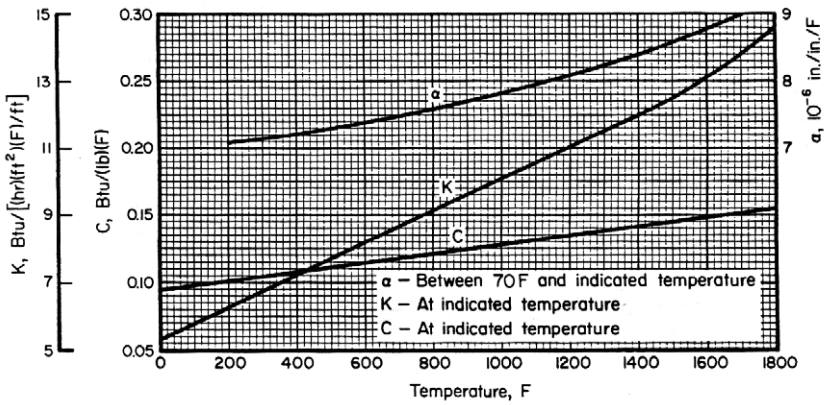
Figure description:
Thermal Properties vs Temperature
Legend
- α - Between 70F and indicated temperature — color: black; symbol: Solid line
- K - At indicated temperature — color: black; symbol: Solid line
- C - At indicated temperature — color: black; symbol: Solid line
| Temperature, F | K [Btu/(hr(ft²(F/ft))) | C [Btu/(lb(F)) | α [10⁻⁶ in./in./F |
|---|---|---|---|
| 0 | 5.8 | 0.094 | null |
| 200 | 7.0 | 0.102 | 7.05 |
| 400 | 8.2 | 0.110 | 7.15 |
| 600 | 9.3 | 0.116 | 7.32 |
| 800 | 10.3 | 0.122 | 7.55 |
| 1000 | 11.3 | 0.129 | 7.82 |
| 1200 | 12.3 | 0.136 | 8.12 |
| 1400 | 13.3 | 0.143 | 8.42 |
| 1600 | 14.5 | 0.150 | 8.78 |
| 1800 | 15.8 | 0.158 | 8.95 |
Notes: The chart displays three different physical properties against Temperature in degrees Fahrenheit. The left-most y-axis corresponds to Thermal Conductivity (K, the inner-left y-axis corresponds to Specific Heat (C, and the right y-axis corresponds to the Coefficient of Thermal Expansion (α.)))
Figure 6.3.3.0. Effect of temperature on the physical properties of Inconel 625.
MIL-HDBK-5J
31 January 2003
| Specification | AMS 5599 | |||||||||
|---|---|---|---|---|---|---|---|---|---|---|
| Form | Sheet and plate | |||||||||
| Condition | Annealed | |||||||||
| Thickness, in. | ≤0.062 | 0.063-0.109 | 0.110-0.140 | 0.141-0.187 | 0.188-0.250 | 0.251-1.000 | ||||
| Basis | A | B | A | B | A | B | A | B | S | S |
| Mechanical Properties: | ||||||||||
| Ftu, ksi: | ||||||||||
| L | 119 | 127 | 119 | 126 | 119 | 125 | 118 | 123 | 119 | |
| LT | 120a | 128 | 120a | 127 | 120a | 126 | 119 | 124 | 120 | 120 |
| Fty, ksi: | ||||||||||
| L | 56 | 62 | 55 | 61 | 54 | 60 | 53 | 59 | 59 | |
| LT | 57 | 63 | 56 | 62 | 55 | 61 | 54 | 60 | 60 | 60 |
| Fcy, ksi: | ||||||||||
| L | 59 | 65 | 58 | 64 | 57 | 63 | 55 | 62 | 62 | |
| LT | 59 | 66 | 58 | 65 | 57 | 64 | 56 | 63 | 63 | |
| Fsu, ksi | 79 | 84 | 79 | 84 | 79 | 83 | 79 | 82 | 79 | |
| Fbru, ksi: | ||||||||||
| (e/D = 1.5) | 202 | 216 | 202 | 214 | 202 | 212 | 201 | 209 | 202 | |
| (e/D = 2.0) | 263 | 281 | 263 | 279 | 263 | 276 | 261 | 272 | 263 | |
| Fbryb, ksi: | ||||||||||
| (e/D = 1.5) | 88 | 97 | 86 | 95 | 84 | 94 | 83 | 92 | 92 | |
| (e/D = 2.0) | 109 | 121 | 107 | 119 | 105 | 117 | 103 | 115 | 115 | |
| e, percent (S-basis): | ||||||||||
| LT | 30 | 30 | 30 | 30 | 30 | 30 | ||||
| E, 103 ksi | 29.8 | |||||||||
| Ec, 103 ksi | 29.8 | |||||||||
| G, 103 ksi | 11.8 | |||||||||
| μ | 0.28 | |||||||||
| Physical Properties: | ||||||||||
| ω, lb/in.3 | 0.305 | |||||||||
| C, K, and α | See Figure 6.3.3.0 | |||||||||
MIL-HDBK-5J
31 January 2003
| Specification | AMS 5666 | |||
|---|---|---|---|---|
| Form | Bar | |||
| Condition | Annealed | |||
| Thickness or diameter, in. | 0.500-0.999 | 1.000-1.999 | 2.000-2.999 | 3.000-3.999 |
| Basis | S | S | S | S |
| Mechanical Properties: | ||||
| Fu, ksi: | ||||
| L | 120 | 120 | 120 | 120 |
| ST | 118 | 118 | ||
| Fty, ksi: | ||||
| L | 60 | 60 | 60 | 60 |
| ST | 57 | 57 | ||
| Fcy, ksi: | ||||
| L | 60 | 59 | 56 | 53 |
| ST | 60 | 60 | ||
| Fsu, ksi | 79 | 79 | 79 | 79 |
| Fbrua, ksi: | ||||
| (e/D = 1.5) | 192 | 192 | 192 | 192 |
| (e/D = 2.0) | 234 | 234 | 234 | 234 |
| Fbrya, ksi: | ||||
| (e/D = 1.5) | 88 | 88 | 88 | 88 |
| (e/D = 2.0) | 102 | 102 | 102 | 102 |
| e, percent (S-basis): | ||||
| L | 30 | 30 | 30 | 30 |
| E, 103 ksi | 29.8 | |||
| Ec, 103 ksi | 29.8 | |||
| G, 103 ksi | 11.8 | |||
| μ | 0.28 | |||
| Physical Properties: | ||||
| ω, lb/in.3 | 0.305 | |||
| C, K, and a | See Figure 6.3.3.0 | |||
MIL-HDBK-5J
6.3.4 INCONEL 706
6.3.4.0
Comments and Properties — Inconel 706 is a vacuum-melted precipitation-hardened, nickel-base alloy with characteristics similar to Inconel 718 except that Inconel 706 has greatly improved machinability. The alloy has good formability and weldability. Like Inconel 718, Inconel 706 has excellent resistance to postweld strain-age cracking.
Depending upon choice of heat treatment, this alloy may be used for applications requiring either (1) high resistance to creep and stress rupture up to 1300 °F or (2) high-tensile strength at cryogenic temperatures or elevated temperatures for short times. The creep-resistant heat treatment is characterized by an intermediate stabilizing treatment before precipitation hardening. Inconel 706 also has good resistance to oxidation and corrosion over a broad range of temperatures and environments.
Because of close relationship between heat treatment properties and application, the form and applications are listed with specifications in Table 6.3.4.0(a). Room-temperature mechanical and physical properties are in Table 6.3.4.0(b). The effect of temperature on physical properties is shown in Figure 6.3.4.0.
| Specification | Form | Application | |
|---|---|---|---|
| AMS 5605 | Sheet, strip, and plate | Tensile | 1800°F solution treated |
| AMS 5606 | Sheet, strip, and plate | Creep-rupture | 1750°F solution treated |
| AMS 5701 | Bar, forging, and ring | Tensile | 1800°F solution treated |
| AMS 5702 | Bar, forging, and ring | Creep-rupture | 1750°F solution treated |
| AMS 5703 | Bar, forging, and ring | Creep-rupture | 1750°F solution treated, stabilized and precipitation treated |
6.3.4.1
Solution-Treated and Aged Condition (Creep Rupture Heat Treatment) —
Effect of temperature on mechanical properties is shown in Figures 6.3.4.1.1, 6.3.4.1.4, and 6.3.4.1.5. Typical tensile stress-strain curves are shown in Figure 6.3.4.1.6(a) and typical compressive stress-strain and tangent- modulus curves in Figure 6.3.4.1.6(b). A full-range tensile stress-strain curve is shown in Figure 6.3.4.1.6(c). Stress-rupture properties are specified at 1200 °F; the appropriate specification should be consulted for detailed requirements.
MIL-HDBK-5J
6.3.5 INCONEL 718
6.3.5.0
Comments and Properties — Inconel 718 is a vacuum-melted, precipitation-hardened nickel-base alloy. It can be welded easily and excels in its resistance to strain-age cracking. It is also readily formable. Depending on choice of heat treatments, this alloy finds applications requiring either (1) high resistance to creep and stress rupture to 1300°F or (2) high strength at cryogenic temperatures. It also has good oxidation resistance up to 1800°F. Inconel 718 is available in all wrought forms and investment castings.
Because of the close relationship between heat treatment, properties, and applications, both the product form and application are listed with the specifications in Table 6.3.5.0(a). Room-temperature mechanical and physical properties are presented in Tables 6.3.5.0(b) through (d). The effect of temperature on physical properties is presented in Figure 6.3.5.0.
| Specification | Form | Application |
|---|---|---|
| AMS 5589 | Tubing | Creep-rupture |
| AMS 5590 | Tubing | Short-time |
| AMS 5596 | Sheet, strip, plate | Creep-rupture |
| AMS 5597 | Sheet, strip, plate | Short-time |
| AMS 5662, 5663 | Bar, forging | Creep-rupture |
| AMS 5664 | Bar, forging | Short-time |
| AMS 5383 | Investment castings | Short-time |
6.3.5.1
Solution-Treated and Aged Condition — Elevated-temperature curves are presented in Figures 6.3.5.1.1 and 6.3.5.1.4(a) through (c). Typical tensile and compressive stress-strain curves as well as typical compressive tangent-modulus curves for sheet and castings are shown in Figures 6.3.5.1.6(a) through (c). Figure 6.3.5.1.6(d ) is a typical stress-strain curve (full range) for Inconel 718 investment casting. Creep and stress-rupture curves for forging are shown in Figures 6.3.5.1.7(a) through (e). Supplemental creep and stress-rupture information for forging is presented in Table 6.3.5.1.7. Fatigue S/N curves are presented in Figures 6.3.5.1.8(a) through (g). Fatigue-crack-propagation data for die forging and plate are presented in Figures 6.3.5.1.9(a) through (c).
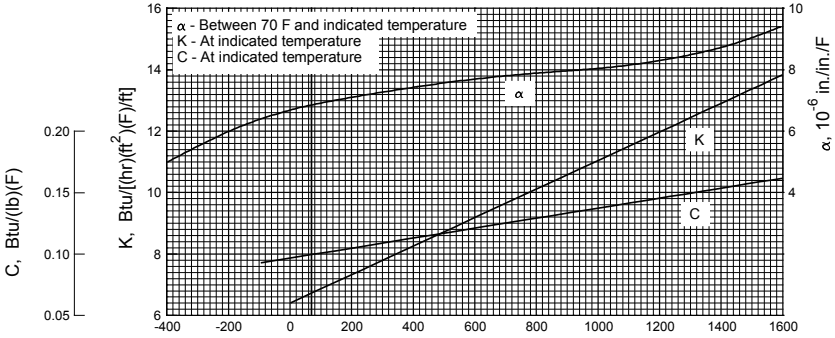
Figure description:
Thermal properties vs Temperature
Legend
- Αlpha — color: black; symbol: Solid line
- K — color: black; symbol: Solid line
- C — color: black; symbol: Solid line
Annotations
- Αlpha - Between 70 F and indicated temperature (text_label - position: Inside top legend box)
- K - At indicated temperature (text_label - position: Inside top legend box)
- C - At indicated temperature (text_label - position: Inside top legend box)
- Reference temperature marker (vertical_line - position: x = 70)
| Temperature (F) | alpha, 10^-6 in./in./F | K, Btu/[(hr(ft^2(F/ft))) | C, Btu/(lb(F)) |
|---|---|---|---|
| -400 | 7.0 | ||
| -300 | 7.3 | ||
| -200 | 7.6 | ||
| -100 | 7.8 | 0.075 | |
| 0 | 8.0 | 6.4 | 0.079 |
| 70 | 8.1 | 6.7 | 0.080 |
| 200 | 8.2 | 7.2 | 0.083 |
| 400 | 8.4 | 8.1 | 0.088 |
| 600 | 8.6 | 9.0 | 0.094 |
| 800 | 8.7 | 10.0 | 0.100 |
| 1000 | 8.9 | 11.0 | 0.104 |
| 1200 | 9.0 | 11.9 | 0.110 |
| 1400 | 9.3 | 12.8 | 0.115 |
| 1600 | 9.6 | 13.8 | 0.118 |
Notes: The chart uses three different y-axes. The innermost left axis scales from 6 to 16 for K (Thermal Conductivity. The outermost left axis scales from 0.05 to 0.20 for C (Specific Heat. The right axis scales from 4 to 10 for Αlpha (Coefficient of Thermal Expansion.)))
Figure 6.3.5.0. Effect of temperature on the physical properties of Inconel 718.
MIL-HDBK-5J
6.3.6 INCONEL X-750
6.3.6.0
Comments and Properties — Inconel X-750 is a high-strength oxidation-resistant nickel-base alloy. It is used for parts requiring high strength up to 1000 °F or high creep strength up to 1500 °F and for low-stressed parts operating up to 1900 °F. It is hardenable by various combinations of solution treatment and aging, depending on its form and application. Inconel X-750 is available in all the usual wrought mill forms.
Inconel X-750 can be readily forged between 1900°F and 2225°F; "hot-cold" working between 1200°F and 1600°F is harmful and should be avoided. This alloy is readily formed but should be solution treated at 1925°F for 7 to 10 minutes after severe forming operations. It is somewhat more difficult to machine than austenitic stainless steels. Rough machining is easier in the solution-treated condition; finish machining in the partly or fully aged condition. Fusion welding is difficult for large section sizes and moderately difficult for small cross sections and sheet. It must be welded in the annealed or solution-treated condition; weldments should be stress relieved at 1650°F for 2 hours before aging. Nickel brazing, followed by precipitation heat treatment of the brazed assembly, results in strength nearly equal to fully heat-treated material.
Oxidation resistance of Inconel X-750 is good to 1900 °F; but the beneficial effects of aging are lost above 1500 °F. This alloy is subject to attack in sulfur-containing atmospheres.
A variety of heat treatments has been developed for Inconel X-750. Each provides special properties and renders the material in the best metallurgical condition for the intended application. Only two of these heat treatments, for applications requiring high strength up to 1100°F, are described below.
Annealed and Aged for Sheet, Strip, and Plate — Mill annealed plus 1300°F for 20 hours, and A.C. per AMS 5542.
Equalized and Aged for Bar and Forging — 1625 °F for 4 hours, A.C., plus 1300 °F for 24 hours, and A.C. per AMS 5667.
Other heat treatments are available for maximum creep-rupture strength.
Some material specifications for Inconel X-750 are shown in Table 6.3.6.0(a). Room-temperature mechanical and physical properties are shown in Table 6.3.6.0(b).
Table 6.3.6.0(a). Material Specifications for
Inconel X-750
| Specification | Form | Condition |
|---|---|---|
| AMS 5542 | Sheet, strip, and plate | Annealed |
| AMS 5667 | Bar and forging | Equalized |
The effect of temperature on the physical properties of this alloy is shown in Figure 6.3.6.0.
6.3.6.1
Annealed and Aged — Elevated-temperature curves for tensile and yield ultimate strengths are shown in Figures 6.3.6.1.1 through 6.3.6.1.3.
6.3.6.2
Equalized and Aged — Elevated-temperature curves are presented in Figures 6.3.6.2.1(a) and (b), as well as 6.3.6.2.4(a) and (b).
Downloaded from https://www.everyspec.com
MIL-HDBK-5J
6.3.7 RENÉ 41
6.3.7.0
Comments and Properties — René 41 is a vacuum-melted precipitation-hardening nickel-base alloy designed for highly stressed parts operating between 1200°F and 1800°F. Its applications include afterburner parts, turbine castings, wheels, buckets, and high-temperature bolts and fasteners. René 41 is available in the form of sheet, bars, and forgings.
René 41 is forged between 1900°F and 2150°F; small reductions must be made when breaking up an as-cast structure; cracking may be encountered in finishing below 1850°F. René 41 work hardens rapidly, and frequent anneals are required; to anneal, heat rapidly to 1950°F for 30 minutes and quench.
René 41 is difficult to machine. In the soft solution-annealed condition it is gummy; therefore, it should be in the fully aged condition for optimum machinability, and tungsten carbide cutting tools should be used. René 41 can be welded satisfactorily in the solution-treated condition; after welding, the parts should be solution treated for stress relief.
René 41 should not be exposed to temperatures above 2050°F during latter stages of hot working or during subsequent operations, otherwise severe intergranular cracking may be encountered.
The oxidation resistance of René 41 is good to 1800°F. Lengthy exposure above the aging temperature (1400°F to 1650°F) results in loss of strength and room-temperature ductility.
Some material specifications for René 41 are shown in Table 6.3.7.0(a). Room temperature mechanical and physical properties are shown in Table 6.3.7.0(b). The effect of temperature on physical properties is shown in Figure 6.3.7.0.
| Specification | Form | Condition |
|---|---|---|
| AMS 5545 | Plate, sheet, and strip | Vacuum melted, solution treated |
| AMS 5712 | Bar and forging | Vacuum melted, solution treated and aged |
| AMS 5713 | Bar and forging | Vacuum melted, solution treated and aged |
6.3.7.1
Solution Treated at 1975 °F and Aged at 1400 °F Condition — Tensile and stress-rupture requirements at elevated temperatures are specified for René 41. The appropriate specification should be consulted for detailed requirements. Other elevated-temperature data for René 41 in this condition are presented in Figures 6.3.7.1.1 through 6.3.7.1.5. A creep nomograph for René 41 alloy sheet is shown in Figure 6.3.7.1.7.
MIL-HDBK-5J
6.3.8 WASPALOY
6.3.8.0
Comments and Properties — Waspaloy is a vacuum-melted precipitation-hardened nickel-base alloy which is strengthened by the precipitation of titanium and aluminum compounds and the solid-solution strengthening effects of chromium, molybdenum, and cobalt. The alloy is designed for highly stressed parts operating at temperatures up to 1550°F, such as aircraft gas turbine blades and discs and rocket engine parts. It is available in all the usual mill forms.
The optimum range for forging is 1900 °F to 2050 °F. Avoid working the alloy below 1900 °F due to danger of cracking and also decreasing the stress-rupture life. Sufficient soaking time between heating is necessary to ensure complete recrystallization; however, avoid excessive long-time soaking at the high forging temperature. Furnace atmospheres should be either neutral or slightly oxidizing to prevent carburization and to minimize scaling.
Waspaloy is relatively difficult to machine. Drilling, turning, etc., can best be accomplished in solution-treated and partially aged condition. Generally, carbine tools are preferred, and positive feeds are required to avoid work hardening. For finish machining, grinding is preferable.
Waspaloy is susceptible to hot cracking or “hot-shortness” above 2150°F; therefore, extreme care should be exercised in the design of weldments so that restraint can be minimized. Waspaloy should be welded in the annealed condition, with minimum heat input, and with rapid cooling by means of chill bars and gas backup. This alloy has good resistance to oxidation at temperatures up to 1750 °F and to combustion products encountered in aircraft gas turbines.
Two heat treatments are used for this material. One is for optimum tensile strength (solution treated 1825 °F to 1900 °F, stabilize 1550 °F, 24 hours air cool, and age 16 hours at 1400 °F air cool), and the other for stress-rupture properties (solution treated 1975 °F, stabilized 1550 °F, 24 hours air cool, age 1400 °F, 16 hours air cool).
Some material specifications for Waspaloy are shown in Table 6.3.8.0(a). Room-temperature mechanical properties are shown in Table 6.3.8.0(b). Physical properties at room and elevated temperatures are shown in Figure 6.3.8.0.
| Specification | Form |
|---|---|
| AMS 5544 | Plate, sheet, and strip |
| AMS 5704 | Forgings |
| AMS 5706 | Bar, forging, ring |
| AMS 5707 | Bar, forging, ring |
| AMS 5708 | Bar, forging, ring |
| AMS 5709 | Bar, forging, ringa |
a Primarily for applications requiring high stress-rupture strength.
6.3.8.1
Aged Condition — Stress rupture requirements at elevated temperatures are specified in material specifications. The appropriate specification should be consulted for detailed requirements. The effect of temperature on various mechanical properties is shown in Figures 6.3.8.1.1, 6.3.8.1.4, as well as 6.3.8.1.5(a) and (b). The effect of temperature on the Ramberg-Osgood parameter, n (tension), is shown in Figure 6.3.8.1.6(a). Typical tensile stress-strain curves are shown in Figure 6.3.8.1.6(b).
MIL-HDBK-5J
6.3.9 HAYNES® 230®*
6.3.9.0
Comments and Properties—HAYNES® 230® alloy provides excellent oxidation resistance up to 2100 °F for prolonged exposures with superior long term stability, high temperature strength and good fabricability. It is produced in the form of plate, sheet, strip, foil, billet, bar, wire welding products, pipe, tubing, remelt bar, and may be cast using traditional air-melt sand mold or vacuum-melt investment foundry techniques. Products are used for gas turbine components in the aerospace industry, catalyst grid supports in the chemical process industry, and various other high-temperature applications.
Environmental Considerations — HAYNES 230 alloy has excellent corrosion resistance to both air and combustion gas oxidizing environments. It also exhibits excellent nitriding resistance and good resistance to carburization and hydrogen embrittlement.
Machining — HAYNES 230 alloy has similar machining characteristics to other solid-solution-strengthened nickel-based alloys. This group of materials is classified moderate to difficult to machine, however, they can be machined using conventional methods at satisfactory rates. They work-harden rapidly, requiring slower speeds and feeds with heavier cuts than would be used for machining stainless steels. See HAYNES publication H-3159 for more detailed information.
Joining — HAYNES 230 alloy has excellent forming and welding characteristics similar to HASTELLOY® X alloy. It is readily welded using GTAW (Gas Tungsten-Arc Welding), GMAW (Gas Metal-Arc Welding), SMAW (Shielded Metal-Arc Welding), and resistance techniques. HAYNES 230-W™ alloy is the recommended filler metal.
Heat Treatment — This alloy is normally final solution heat-treated between 2150°F and 2275°F. Annealing during fabrication can be performed at slightly lower temperatures, but a final subsequent solution heat treatment followed by rapid cooling is needed to produce optimum properties and structure.
Specifications and Properties — Material specifications are shown in Table 6.3.9.0(a).
Table 6.3.9.0(a). Material Specifications for
HAYNES 230 Alloy Wrought
| Specification | Form |
|---|---|
| AMS 5878 | Plate, sheet, and strip |
| AMS 5891 | Bar and forging |
Room temperature mechanical and physical properties are shown in Tables 6.3.9.0(b) and (c).
6.3.9.1
Annealed Condition — Elevated temperature mechanical properties are shown in Figures 6.3.9.1.1(a) and (b). Typical stress-strain and full-range curves are shown in Figure 6.3.9.1.6(a) and (b).
MIL-HDBK-5J
6.3.10 HAYNES® HR-120®*
6.3.10.0
Comments and Properties — HAYNES HR-120 alloy is a solid-solution strengthened Fe-Ni-Cr alloy with excellent high temperature strength, very good resistance to carburizing and sulfiding environments, and readily formed hot or cold.
Environmental Considerations — HAYNES HR-120 alloy has very good sulfide and carburization resistance. Oxidation resistance is comparable to other Fe-Ni-Cr materials such as alloys 330 and 800H, yet with a greater strength at temperatures up to 2000°F.
Machining — This alloy is readily machinable using conventional practices similar to those for 300 series austenitic stainless steels. Minor adjustments may be required to yield optimum results. See HAYNES publication H-3125B for more detailed information.
Joining — Welding characteristics are similar to the HASTELLOY® alloys. The alloy is readily welded using GTAW (Gas Tungsten-Arc Welding), GMAW (Gas Metal-Arc Welding), and SMAW (Shielded Metal-Arc Welding) techniques. HAYNES® 556™ alloy is the recommended filler wire (AMS5831) for GTAW and GMAW processes. Multimet® alloy covered electrode (AMS 5795) is recommended for SMAW processes. HASTELLOY® X alloy filler wire (AMS 5798) and covered electrode (AMS 5799) may also be used.
Heat Treatment — This alloy is solution annealed between 2150°F and 2250°F and rapidly cooled.
Specifications and Properties — Material specifications are shown in Table 6.3.10.0(a).
| Specification | Form |
|---|---|
| AMS 5916 | Sheet, strip and plate |
Room temperature mechanical and physical properties are shown in Table 6.3.10.0(b).
6.3.10.1
Annealed Condition — Elevated temperature tensile properties are shown in Figure 6.3.10.1.1(a). Stress rupture curves are shown in Figures 6.3.10.1.7(a) and (b)