The alpha titanium alloys contain essentially a single phase at room temperature, similar to that of unalloyed titanium. Alloys identified as near-alpha titanium have principally an all-alpha structure but contain small quantities of a beta phase because the composition contains some beta stabilizing elements. In both alloy types, alpha phase is stabilized by aluminum, tin, and zirconium. These elements, especially aluminum, contribute greatly to strength. The beta stabilizing additions (e.g., molybdenum and vanadium) improve fabricability and metallurgical stability of highly alpha-alloyed materials.
All alpha alloys have excellent weldability, toughness at low temperatures, and long-term elevated-temperature strength. They are well suited to cryogenic applications and to uses requiring good elevated-temperature creep strength. The characteristics of near-alpha alloys are predictably between those of all alpha and alpha-beta alloys in regard to fabricability, weldability, and elevated-temperature strength. The hot workability of both alpha and near-alpha alloys is inferior to that of the alpha-beta or beta alloys and the cold workability is very limited at the high-strength level of these grades. However, considerable forming is possible if correct forming temperatures and procedures are used.
5.3.1 Ti-5Al-2.5Sn
5.3.1.0
Comments and Properties — Ti-5Al-2.5Sn is an all-alpha alloy available in many product forms and at two purity levels. The high purity grade of this composition is used principally for cryogenic applications and may be characterized as having lower strength but higher ductility and toughness than the standard grade. The normal purity grade also may be used at low temperatures but it is primarily suitable for room to elevated temperature applications (up to 900°F or to 1100°F for short times) where weldability is an important consideration.
Manufacturing Considerations—Ti-5Al-2.5Sn is not so readily formed into complex shapes as other alloys with similar room-temperature properties, but far surpasses them in weldability. Except for some forging operations, fabrication of Ti-5Al-2.5Sn is conducted at temperatures where the structure remains all alpha. Severe forming operations may be accomplished at temperatures up to 1200 °F. Moderately severe forming can be done at 300 to 600 °F and simple forming may be done at room temperature. Most forming and welding operations are followed by an annealing treatment to relieve residual stresses imposed by the prior operation.
Ti-5Al-2.5Sn can be welded readily by inert-gas or vacuum-shielded arc methods or by spot or seam welding without atmospheric shielding. Brazing requires protection from the atmosphere; however, this is accomplished by fluxing as well as by inert gas or vacuum shielding.
Environmental Considerations — Ti-5Al-2.5Sn is metallurgically stable at moderate elevated temperatures. The material is susceptible to hot-salt stress corrosion as well as aqueous chloride solution stress corrosion. Care should be exercised in applications involving such environments. The alloy has good oxidation resistance up to 1050°F. Standard grade material has been used at moderately low cryogenic temperatures; however, the ELI grade has higher toughness and has been used in cryogenic applications down to -423 °F. Under certain conditions, titanium, when in contact with cadmium, silver, mercury, or certain of their compounds, may become embrittled. Refer to MIL-HDBK-1568 for restrictions concerning applications with titanium in contact with these metals or their compounds.
Heat Treatment — This alloy is annealed by heating 1400°F for 60 minutes and 1600°F for 10 minutes and cooling in air. Stress relieving requires 1 or 2 hours at 1000 to 1200°F. Ti-5Al-2.5Sn cannot be hardened by heat treatment.
MIL-HDBK-5J
5.3.1.1
Annealed Condition — Elevated temperature curves for annealed Ti-5Al-2.5Sn are shown in Figures 5.3.1.1.1 through 5.3.1.1.5. Tensile properties cover the range -423 °F to 1000 °F; whereas other properties are for the range room temperature to 1000°F. Fatigue-crack-propagation data for sheet are shown in Figures 5.3.1.1.9(a) through (c).
MIL-HDBK-5J
5.3.2 Ti-8AL-1Mo-1V
5.3.2.0
Comments and Properties — Ti-8Al-1Mo-1V alloy is a near-alpha composition developed for improved creep resistance and thermal stability up to about 850 °F. The alloy is available as billet, bar, plate, sheet, strip, extrusions, and forgings.
Manufacturing Considerations — Room temperature forming of Ti-8Al-1Mo-1V sheet is somewhat more difficult than in Ti-6Al-4V, and for severe operations hot forming is required. Ti-8Al-1Mo-1V can be fusion welded readily with inert-gas protection or spot welding without atmospheric protection. Weld strengths are comparable to those of the parent metal although ductility is somewhat lower in the weldment.
Environmental Considerations — Ti-8Al-1Mo-1V exhibits good oxidation resistance and thermal stability up to 850°F. A decrease in tensile elongation has been reported for single-annealed sheet following 150 hours stressed exposure at 1000°F. Extended exposure to temperatures exceeding 600°F adversely affects room-temperature spot-weld tension strength. This alloy is not recommended for structural applications at liquid-hydrogen temperatures (-423°F). The Ti-8Al-1Mo-1V alloy also is susceptible to chloride stress-corrosion attack in either elevated-temperature (hot-salt stress-corrosion) or ambient-temperature (aqueous stress-corrosion) chloride environments. Thus, care should be exercised in applying the material in chloride containing environments. Under certain conditions, titanium, when in contact with cadmium, silver, mercury, or certain of their compounds, may become embrittled. Refer to MIL-S-5002 and MIL-STD-1568 for restrictions concerning applications with titanium in contact with these metals or their compounds.
Heat Treatment — Three treatments are used with Ti-8Al-1Mo-1V. These are:
Single Anneal: 1450°F for 8 hours, furnace cool.
Duplex Anneal: 1450°F for 8 hours, furnace cool, followed by 1450°F for 15 to 20 minutes, air cool.
Solution Treated and Stabilized: 1825°F for 1 hour, air cool, 1075°F for 8 hours, air cool.
As a general guide, the single anneal is used to obtain highest room-temperature mechanical properties and the duplex anneal to obtain highest fracture toughness. Both the single anneal and the duplex anneal are compatible with hot-forming operations. The solution treated and stabilized condition is used for forgings.
Specifications and Properties — Material specifications for Ti-8Al-1Mo-1V are presented in Table 5.3.2.0(a). Room-temperature mechanical and physical properties for Ti-8Al-1Mo-1V are shown in Tables 5.3.2.0(b) and (c). The effect of temperature on physical properties is shown in Figure 5.3.2.0.
Table 5.3.2.0(a). Material Specifications for
Ti-8Al-1Mo-1V
| Specification | Form |
|---|---|
| AMS-T-9046 | Sheet, strip, and plate |
| MIL-T-9047 | Bar |
| AMS 4973 | Forging |
| AMS 4915 | Sheet, strip, and plate |
| AMS 4916 | Sheet, strip, and plate |
MIL-HDBK-5J
5.3.2.1
Single-Annealed Condition — Cryogenic, room-temperature, and elevated temperature property curves for this condition are shown in Figures 5.3.2.1.1 and 5.3.2.1.4. Typical tensile and compressive stress-strain and tangent-modulus curves are shown in Figures 5.3.2.1.6(a) and (b) for room temperature and several elevated temperatures.
5.3.2.2
Duplex-Annealed Condition — Cryogenic, room temperature, and elevated temperature curves for this condition are shown in Figure 5.3.2.2.1. Typical tensile and compressive stress-strain and tangent-modulus curves are shown in Figures 5.3.2.2.6(a) and (b) for room temperature and several elevated temperatures. Fatigue S/N curves for unnotched and notched specimens at room temperature and several elevated temperatures are shown in Figures 5.3.2.2.8(a) through (f).
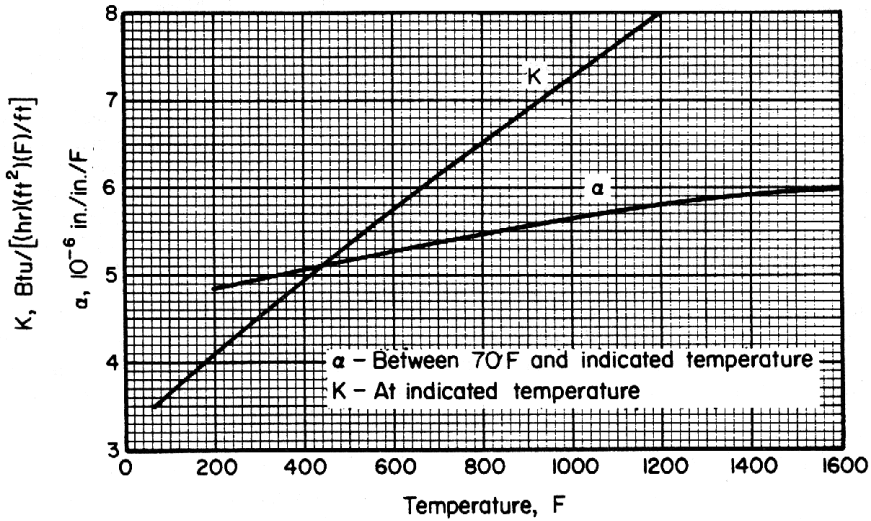
Figure description:
K, Btu/[(hr(ft^2(F/ft and α, 10^-6 in./in./F vs Temperature, F
Material Thermal Properties vs Temperature
Legend
- K - At indicated temperature — color: black; symbol: solid line labeled 'K'
- α - Between 70 F and indicated temperature — color: black; symbol: solid line labeled 'α'
| Temperature (F) | K, Btu/[(hr(ft^2(F/ft))) | α, 10^-6 in./in./F |
|---|---|---|
| 65 | 3.50 | null |
| 100 | 3.65 | null |
| 200 | 4.10 | 4.85 |
| 300 | 4.55 | 4.95 |
| 400 | 5.00 | 5.05 |
| 500 | 5.42 | 5.15 |
| 600 | 5.85 | 5.25 |
| 700 | 6.25 | 5.35 |
| 800 | 6.65 | 5.45 |
| 900 | 7.05 | 5.55 |
| 1000 | 7.40 | 5.65 |
| 1100 | 7.75 | 5.75 |
| 1200 | 8.00 | 5.82 |
| 1300 | null | 5.88 |
| 1400 | null | 5.93 |
| 1500 | null | 5.97 |
| 1600 | null | 6.00 |
Notes: The chart displays thermal conductivity (K and the coefficient of thermal expansion (α as functions of temperature. The horizontal axis represents Temperature in degrees Fahrenheit (F, ranging from 0 to 1600. The vertical axis covers a range from 3 to 8, applicable to both K (in Btu/[(hr(ft^2(F/ft and α (in 10^-6 in./in./F.))))))))
Figure 5.3.2.0. Effect of temperature on the physical properties of Ti-8Al-1Mo-1V alloy.
Downloaded from https://www.everyspec.com MIL-HDBK-5J
5.3.3 Ti-6Al-2Sn-4Zr-2Mo
5.3.3.0
Comments and Properties — Ti-6Al-2Sn-4Zr-2Mo is a near-alpha titanium composition developed for improved elevated-temperature performance. The alloy has a titanium-aluminum base that is solid solution strengthened by additions of tin and zirconium. Molybdenum improves both room and elevated temperature strength, creep and thermal stability. Introduction of this alloy initially met the requirements for certain advanced performance gas turbine engine applications. Some of the more recent applications, however, require better creep strength than the alloy initially provided. Development work showed that a small addition of silicon, approximately 0.08 percent, substantially improved the creep strength of the alloy without significantly affecting the thermal stability. The alloy is creep resistant and relatively stable to about 1050°F. Creep and thermal stability of the alloy are further enhanced by solution treating high in the alpha-beta phase field. The alloy is available in bar, billet, plate, sheet, strip, and extrusions.
Manufacturing Conditions — Forging of Ti-6Al-2Sn-4Zr-2Mo at temperatures below the beta transus temperature is recommended. For optimum creep properties beta forging or a modification of it is recommended with some loss in ductility to be expected. Elevated temperatures may be used for severe sheet forming operations while room-temperature forming may be used for mild contouring. Stress relief annealing may be combined with a final hot-sizing operation. The material can be welded using TIG or MIG fusion processes to achieve 100 percent joint efficiencies but with limited weld zone ductility. As in welding any titanium alloy, shielding from atmospheric contamination is required except for spot or seam welding.
Environmental Considerations — Ti-6Al-2Sn-4Zr-2Mo is somewhat more resistant to hot-salt cracking than either Ti-8Al-1Mo-1V or Ti-6Al-4V alloys. The material is marginally susceptible to aqueous chloride solution stress-corrosion cracking. Surface oxides formed during exposure to service temperature (~950°F) do not adversely affect properties. Under certain conditions, titanium, when in contact with cadmium, silver, mercury, or certain of their compounds, may become embrittled. Refer to MIL-S-5002 and MIL-STD-1568 for restrictions concerning applications with titanium in contact with these metals or their compounds.
Heat Treatment — Several different annealing treatments, which are described below, are available for Ti-6Al-2Sn-4Zr-2Mo.
For sheet and strip:
Duplex Anneal: 1650°F for ½ hour, air cool, followed by 1450°F for ¼ hour, and air cool.
Triplex Anneal: 1650°F for ½ hour, air cool, followed by 1450°F for ¼ hour, air cool, followed by 1100°F for 2 hours and air cool.
For plate:
Duplex Anneal: 1650°F for 1 hour, air cool, followed by 1100°F for 8 hours and air cool.
Triplex Anneal: 1650°F for ½ hour, air cool, followed by 1450°F for ¼ hour, air cool, followed by 1100°F for 2 hours and air cool.
For bars and forgings:
Duplex Anneal: Solution anneal 25 to 50°F below beta transus temperature for 1 hour, air cool or faster, followed by 1100°F for 8 hours and air cool.
5.3.3.1
Single, Duplex, and Triplex Annealed — Room and elevated temperature property curves are shown in Figures 5.3.3.1.1, 5.3.3.1.2, and 5.3.3.1.4. Typical stress-strain curves at room and elevated temperatures are shown in Figures 5.3.3.1.6(a) and (b). Full range stress-strain curves at room and elevated temperatures are shown in Figure 5.3.3.1.6(c).
— — a b c d e
| Specification | AMS 4919 | AMS-T-9046, Comp. AB-4 | |||||||
|---|---|---|---|---|---|---|---|---|---|
| Form | Sheet | ||||||||
| Condition | Duplex annealed | Triplex annealed | |||||||
| Thickness or diameter, in. | ≤0.046 | 0.047-0.093 | 0.094-0.140 | 0.141-0.187 | ≤0.187 | ||||
| Basis | A | B | A | B | A | B | A | B | Sa |
| Mechanical Properties: | |||||||||
| Ftu, ksi: | |||||||||
| L | 135b | 143 | 135b | 143 | 135b | 143 | 135b | 143 | 145 |
| LT | 135b | 143 | 135b | 143 | 135b | 143 | 135b | 143 | 145 |
| Fy, ksi: | |||||||||
| L | 125c | 136 | 125c | 136 | 125c | 136 | 125c | 136 | 135 |
| LT | 125c | 134 | 125c | 134 | 125c | 134 | 125c | 134 | 135 |
| Fcy, ksi: | |||||||||
| L | 132 | 142 | 132 | 142 | 132 | 142 | 132 | 142 | |
| LT | 132 | 142 | 132 | 142 | 132 | 142 | 132 | 142 | |
| Fsu, ksi | |||||||||
| Fbru, ksi: | |||||||||
| (e/D=1.5) | 195 | 206 | 205 | 217 | 214 | 227 | 219 | 232 | |
| (e/D=2.0) | 217 | 230 | 243 | 258 | 266 | 282 | 279 | 295 | |
| Fbry, ksi: | |||||||||
| (e/D=1.5) | 171 | 183 | 171 | 183 | 171 | 183 | 171 | 183 | |
| (e/D=2.0) | 202 | 217 | 202 | 217 | 202 | 217 | 202 | 217 | |
| e, percent (S-basis): | |||||||||
| L | 8e | e | 10 | 10 | 0e | ||||
| LT | 8e | e | 10 | 10 | 0 | ||||
| E, 103 ksi | 16.5 | ||||||||
| Ec, 103 ksi | 18.0 | ||||||||
| G, 103 ksi | 6.2 | ||||||||
| μ | 0.32 | ||||||||
| Physical Properties: | |||||||||
| ω, lb/in.3 | 0.164 | ||||||||
| C, K and α | See Figure 5.3.3.0 | ||||||||