6.2.0
GENERAL COMMENTS — The alloys in this group, in terms of cost and in maximum service temperature, generally fall between the austenitic stainless steels and the nickel- and cobalt-base alloys. They are used in airframes, principally, in the temperature range 1000 to 1200 °F, in those applications in which the stainless steels are inadequate and service requirements do not justify the use of the more costly nickel or cobalt alloys.
6.2.0.1 Metallurgical Considerations
Composition — The complex-base alloys comprising this group range from those in which iron is considered the base element to those which border on the nickel-base alloys. All of them contain sufficient alloying elements to place them in the “Superalloy” category, yet contain enough iron to reduce their cost considerably.
Chromium, in amounts ranging from 10 to 20 percent or higher, primarily increases oxidation resistance and contributes to strengthening of these alloys. Nickel and cobalt strengthen and toughen these materials. Molybdenum, tungsten, and columbium contribute to hardness and strength, particularly at elevated temperatures. Titanium and aluminum are added to provide age-hardening.
Heat Treatment — The complex-base alloys are heat treated with conventional equipment and fixtures such as would be used for austenitic stainless steels. Since these alloys are susceptible to carburization during heat treatment, it is good practice to remove all grease, oil, cutting, lubricant, etc., from the surface before heating. A low-sulfur and neutral or slightly oxidizing furnace atmosphere is recommended for heating.
6.2.0.2
Manufacturing Considerations — The iron-chromium-nickel-base alloys closely resemble the austenitic stainless steels insofar as forging, cold forming, machining, welding, and brazing are concerned. Their higher strength may require the use of heavier forging or forming equipment, and machining is somewhat more difficult than for the stainless steels. Pertinent comments are included under the individual alloys.
6.2.1 A-286
6.2.1.0
Comments and Properties — A-286 is a precipitation-hardening iron-base alloy designed for parts requiring high strength up to 1300°F and oxidation resistance up to 1500 °F. It is used in jet engines and gas turbines for parts such as turbine buckets, bolts, and discs, and sheet metal assemblies. A-286 is available in the usual mill forms.
A-286 is somewhat harder to hot or cold work than the austenitic stainless steels. Its forging range is 2150 to 1800°F; when finishing below 1800°F, light reductions (under 15 percent) must be avoided to prevent grain coarsening during subsequent heat treatment. A-286 is readily machined in the partially or fully aged condition but is soft and "gummy" in the solution-treated condition. A-286 should be welded in the solution-treated condition. Fusion welding is difficult for large section sizes and moderately difficult for small cross sections and sheet. Cracking may be encountered in the welding of heavy sections or parts under high restraint. A dimensional contraction of 0.0008 inch per inch is experienced during aging. Oxidation resistance of A-286 is equivalent to that of Type 310 stainless steel up to 1800°F.
Some material specifications for A-286 alloy are presented in Table 6.2.1.0(a). Room-temperature mechanical and physical properties are shown in Table 6.2.1.0(b). The effect of temperature on physical properties is shown in Figure 6.2.1.0.
MIL-HDBK-5J
6.2.1.1
Solution-Treated and Aged Condition — Elevated-temperature data are presented in Figures 6.2.1.1.1, 6.2.1.1.3, and 6.2.1.1.4(a) through (c). Stress rupture properties are specified at 1200 °F; the appropriate specifications should be consulted for detailed requirements. Figures 6.2.1.1.8(a) through (e) are fatigue S/N curves for several elevated temperatures.
| Specification | Form | Condition |
|---|---|---|
| AMS 5525 | Sheet, strip, and plate | Solution treated (1800°F) |
| AMS 5731 | Bar, forging, tubing, and ring | Solution treated (1800°F) |
| AMS 5732 | Bar, forging, tubing, and ring | Solution treated (1800°F) and aged |
| AMS 5734 | Bar, forging, and tubing | Solution treated (1650°F) |
| AMS 5737 | Bar, forging, and tubing | Solution treated (1650°F) and aged |
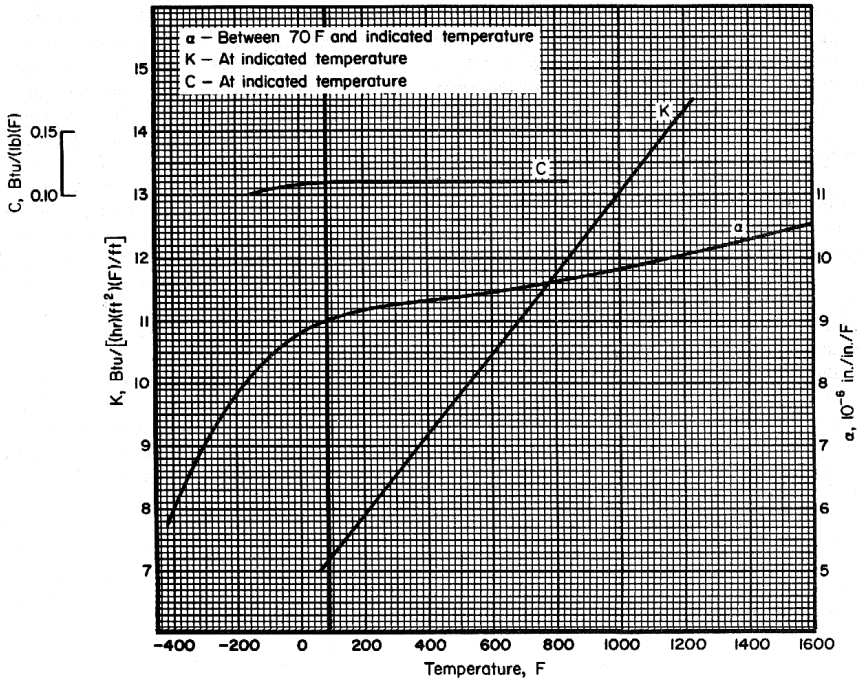
Figure description:
Material Properties as a Function of Temperature
Legend
- α - Between 70 F and indicated temperature — color: black; symbol: Solid line
- K - At indicated temperature — color: black; symbol: Solid line
- C - At indicated temperature — color: black; symbol: Solid line
Annotations
- α scale: 10^-6 in./in./F (text_label - position: Right y-axis)
- K scale: Btu/[(hr(ft^2(F/ft (text_label - position: Left y-axis (inner)))))
- C scale: Btu/(lb(F (text_label - position: Left y-axis (inset, top))))
| Temperature (F) | K [Btu/((hr(ft^2(F/ft)))) | α [10^-6 in./in./F | C [Btu/(lb(F)) |
|---|---|---|---|
| -400 | 7.8 | null | null |
| -300 | 8.8 | null | null |
| -200 | 9.7 | null | 0.100 |
| -100 | 10.3 | null | 0.103 |
| 0 | 10.8 | null | 0.106 |
| 70 | 11.0 | 5.0 | 0.107 |
| 100 | 11.1 | 5.2 | 0.108 |
| 200 | 11.2 | 5.7 | 0.110 |
| 400 | 11.4 | 6.7 | 0.111 |
| 600 | 11.5 | 7.6 | 0.111 |
| 800 | 11.7 | 8.6 | 0.112 |
| 1000 | 11.9 | 9.7 | null |
| 1200 | 12.1 | 10.6 | null |
| 1400 | 12.3 | null | null |
| 1600 | 12.5 | null | null |
Notes: The data series were assigned based on the legend definitions: Curve 'K' is the long curve from -400F to 1600F; Curve 'α' is the steep curve starting at 70F; Curve 'C' is the nearly horizontal curve from -200F to 800F. Note that 'α' values are read from the right-hand axis, 'K' values from the inner left-hand axis, and 'C' values from the separate inset scale on the left.
Figure 6.2.1.0. Effect of temperature on the physical properties of A-286.
MIL-HDBK-5J
6.2.2 N-155
6.2.2.0
Comments and Properties — N-155 alloy, also known as Multimet, is designed for applications involving high stress up to 1500 °F. It has good oxidation properties and good ductility and can be fabricated readily by conventional methods. This alloy has been used in many aircraft applications, including afterburner parts, combustion chambers, exhaust assemblies, turbine parts, and bolting.
N-155 is forged readily between 1650°F and 2200 °F. It is easily formed by conventional methods; intermediate anneals may be required to restore its ductility. This alloy is machinable in all conditions; low cutting speeds and ample flow of coolant are required. The weldability of N-155 is comparable to that of the austenitic stainless steels. The oxidation resistance of N-155 sheet is good up to 1500 °F.
Some materials specifications for N-155 are presented in Table 6.2.2.0(a). Room-temperature mechanical and physical properties for N-155 sheet and tubing in the solution-treated (annealed) condition are presented in Table 6.2.2.0(b). Bars and forgings are not specified by room-temperature properties but have specific elevated-temperature requirements. The effect of temperature on physical properties is shown in Figure 6.2.2.0.
| Specification | Form | Condition |
|---|---|---|
| AMS 5532 | Sheet | Solution treated |
| AMS 5585 | Tubing (welded) | Solution treated |
| AMS 5768 | Bar and forging | Solution treated and aged |
| AMS 5769 | Bar and forging | Solution treated |
6.2.2.1
Solution-Treated Condition — Elevated-temperature curves are presented in Figures 6.2.2.1.1(a) and (b), as well as 6.2.2.1.4(a) and (b). Stress-rupture properties are specified at 1500 °F for sheet and at 1350 °F for bars and forgings; the appropriate specifications should be consulted for detailed requirements.
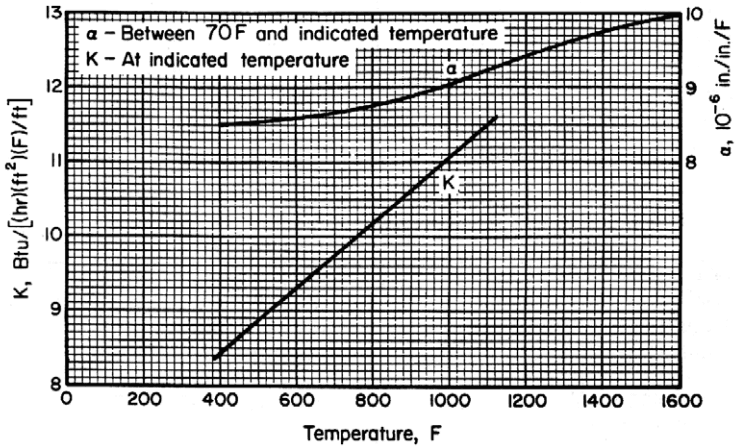
Figure description:
Thermal Conductivity (K and Coefficient of Linear Expansion (a vs Temperature
Legend
- a - Between 70F and indicated temperature — color: black; symbol: solid line
- K - At indicated temperature — color: black; symbol: solid line
Annotations
- a (text_label - position: above curve near T=1000 F)
- K (text_label - position: below curve near T=1000 F)
| Temperature, F | K, Btu/[(hr(ft²(F/ft))) | a, 10⁻⁶ in./in./F |
|---|---|---|
| 400 | 8.35 | 8.50 |
| 500 | 8.80 | 8.54 |
| 600 | 9.25 | 8.60 |
| 700 | 9.70 | 8.68 |
| 800 | 10.15 | 8.80 |
| 900 | 10.60 | 8.92 |
| 1000 | 11.05 | 9.06 |
| 1100 | 11.50 | 9.22 |
| 1125 | 11.61 | 9.26 |
| 1200 | null | 9.38 |
| 1300 | null | 9.53 |
| 1400 | null | 9.69 |
| 1500 | null | 9.84 |
| 1600 | null | 10.00 |
Notes: The chart features two y-axes: the left axis for Thermal Conductivity (K and the right axis for the Coefficient of Linear Expansion (a. The temperature range for K is approximately 400 to 1125 F, while the range for 'a' is approximately 400 to 1600 F.))
Figure 6.2.2.0. Effect of temperature on the physical properties of N-155 alloy.