The provisions for seismic design of H-piles are based on the data collected on the actual behavior of H-piles, including the 1994 Northridge earthquake (Astaneh-Asl et al., 1994) and the results of full-scale cyclic pile tests (Astaneh-Asl and Ravat, 1997). In the test program, five full-size H-piles with reinforced concrete pile caps were subjected to realistic cyclic vertical and horizontal displacements expected in a major earthquake. Three specimens were vertical piles, and two specimens were batter piles. The tests established that during cyclic loading for all three vertical pile specimens, a very ductile and stable plastic hinge formed in the steel pile just below the reinforced concrete pile cap. When very large inelastic cycles were applied, local buckling of flanges within the plastic hinge area occurred. Eventually, low-cycle fatigue fracture of flanges or overall buckling of the pile occurred. However, before the piles experienced fracture through locally buckled areas, vertical piles tolerated from 40 to 65 large inelastic cyclic vertical and horizontal displacements with rotation of the plastic hinge exceeding 0.06 rad for more than 20 cycles.
D4.1 Design Requirements
Prior to an earthquake, piles, particularly vertical piles, are primarily subjected to gravity axial load. During an earthquake, piles are subjected to horizontal and vertical displacements as shown in Figure C-D4.1. The horizontal and vertical displacements of piles generate axial load; compression; and possibly uplift tension, bending moment, and shear in the pile.
The lateral deflections can be particularly high in locations where upper soil layers are soft or where soils may be prone to liquefaction. A case study of the performance of H-piles during the 1994 Northridge earthquake (Astaneh-Asl et al., 1994) investigated H-piles where the upper layers were either in soft soil or partially exposed. During tests of H-piles, realistic cyclic horizontal and vertical displacements were applied to the pile specimens. Figure C-D4.2 shows test results in terms of axial load and bending moment for one of the specimens. Based on the performance of test specimens, it was concluded that H-piles should be designed following the provisions of the Specification for members subjected to combined loads. H-piles in soft soil conditions are expected to undergo significant lateral displacements and develop high bending forces and possibly plastic hinges near the pile cap. Consequently, H-piles
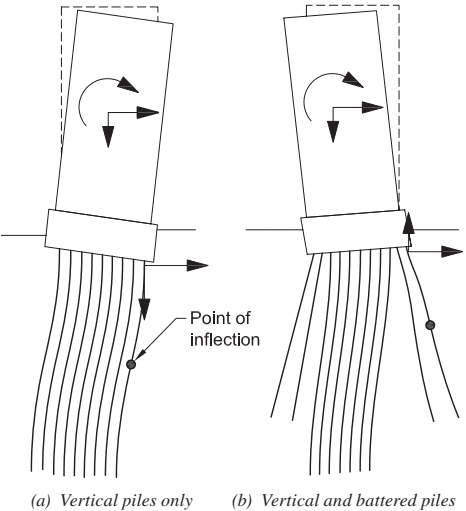
Figure description:
Key Information:
- Figure Title: Deformations of piles and forces acting on an individual pile (Fig. C-D4.1.
- Scenario (a Vertical piles only: Shows the lateral deflection and curvature of a foundation system consisting entirely of vertical piles.
- Scenario (b Vertical and battered piles: Shows the deformation pattern for a foundation combining vertical and angled (battered piles.
- Applied Loads: The upper structure is subjected to horizontal force, vertical force, and a bending moment.
- Forces on Individual Pile: Internal axial (vertical and shear (horizontal forces are indicated at the connection between the outermost pile and the pile cap.
- Deformation Details:
- Dashed lines represent the original undeformed state.
- Solid lines represent the deflected state under load.
- Point of inflection: Identifies the location on the pile where the curvature changes, signifying the distribution of bending stresses.
Fig. C-D4.1. Deformations of piles and forces acting on an individual pile.
in soft soil conditions necessitate a compactness requirement that ensures ductile inelastic behavior. The flange compactness requirement is less stringent than that of I-shaped beams and is based on the width-to-thickness of the H-piles tested in the Astaneh study given their good performance.
D4.2 Battered H-Piles
The vertical pile specimens demonstrated very large cyclic ductility as well as considerable energy dissipation capacity. A case study of performance of H-piles during the 1994 Northridge earthquake (Astaneh-Asl et al., 1994) indicated excellent performance for pile groups with vertical piles only. However, the battered pile specimens did not show as much ductility as the vertical piles. The battered piles tolerated from 7 to 17 large inelastic cycles before failure. Based on relatively limited information on actual seismic behavior of battered piles, it is possible that during a major earthquake, battered piles in a pile group fail and are no longer able to support the gravity load after the earthquake. Because of this possibility, the use of battered piles to carry gravity loads is discouraged. Unless, through realistic cyclic tests, it is shown that battered piles will be capable of carrying their share of the gravity loads after a major earthquake, the vertical piles in seismic design categories D, E, and F should be designed to support the gravity load alone, without participation of the battered piles.
D4.3 Tension
Due to overturning moment, piles can be subjected to tension. Piles subjected to ten-sion should have sufficient mechanical attachments within their embedded area to transfer the tension force in the pile to the pile cap or foundation.
Fig. C-D4.2. Axial load-moment interaction for H-pile test.
H-piles used in higher seismic design categories are expected to yield just under the pile cap or foundation because of combined bending and axial load. Design and detailing requirements for H-piles are intended to produce stable plastic hinge formation in the piles. Because piles can be subjected to tension caused by overturning moment, mechanical means to transfer such tension must be designed for the required tension force, but not less than 10% of the pile compression capacity.
D4.4 Protected Zone
Because it is anticipated that during a major earthquake, a plastic hinge is expected to form in H-piles in soft soil conditions just under the pile cap or foundation, the use of mechanical attachment and welds over a length of pile below the pile cap equal to the depth of the pile cross section is prohibited. This region is therefore designated as a protected zone.