The fastener's load deflection relationship is given by,
where; is the tensile load in the fastener shank, is its stiffness, is its elongation and is its compliance.
In the general case of a fastener with varying shank diameters, such as Figure 7-9, the total elongation of the fastener is the sum of the elongations of its constituent segments (i.e. head, nut, and shank). In general, the different parts of the fastener have different local stiffness properties. Thus the total elongation can be written,
where are the elongations of the constituent segments.
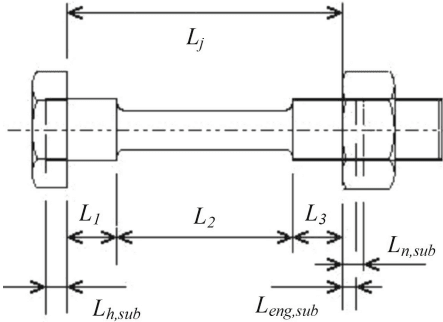
Figure description:
Key Entities:
- Fastener Assembly: Consists of a bolt head, a shank with varying diameters, and a nut.
- Dimensional Parameters: Defined lengths for segments of the fastener.
Visible Text Labels and Dimensions:
- : Total length between the bearing surface of the bolt head and the bearing surface of the nut.
- : Length of the first (thicker segment of the bolt shank.
- : Length of the middle (thinner segment of the bolt shank.
- : Length of the third segment of the bolt shank extending to the nut.
- : Substitution length within the bolt head.
- : Engaged substitution length where the bolt enters the nut.
- : Substitution length within the nut.
Applying Hooke’s law to each segment,
where; is the Young's modulus of the fastener material and is the local cross section of the segment.
Combining the above equations [7.5.2] and [7.5.3], the compliance of the fastener is then,
Expanding [7.5.4] and introducing substitution lengths for deformations in the head, the fastener's engaged region and the nut's engaged region gives,
Figure description:
Text: ECSS Visual Elements:
- A purple-bordered parallelogram.
- A white parallelogram on the left containing a purple, italicized, serif letter "E".
- White, italicized, serif letters "CSS" on a purple background. Key Entity: ECSS
where; , and are the substitution lengths for deformations within the head, engaged shank and engaged nut or insert (see Table 7-1), is the fastener's nominal cross-sectional area, is the fasteners minor diameter area (see Figure 5-5), is the effective cross-sectional area at the 'th segment of the fastener's shank and is the length of the 'th segment of the fastener's shank.
In many cases when using Equation [7.5.5] only one segment of fastener’s shank needs to be considered. However, if the fastener has varying shank diameters, it is important to include the length and effective stiffness area of each segment.
Table 7-1 shows typical substitution lengths for standardised fasteners, which can be used in Equation [7.5.5]. The table only includes values for typical hexagon heads, cylindrical heads and nuts. The same analysis method can be applied to other fastener heads and nuts, and it is important to determine the appropriate substitution lengths by experiment or analysis.
| Part of Fastener | Parameter | Fastener/Joint Configuration | Typical Substitution Length |
|---|---|---|---|
| Head | Lh,sub | Hexagon head | 0,5 d |
| Cylindrical head | 0,4 d | ||
| Locking device (nut or insert) | Ln,sub | Nut-Tightened | 0,4 d |
| Threaded hole | 0,33 d | ||
| Engaged shank | Leng,sub | Any | 0,5 d |