Consider the joint illustrated in Figure 7-1. This comprises a fastener, nut and two flanges. In the absence of externally applied loads the fastener preload is equal and opposite to the clamping load (the compression force acting between the clamped parts). During service the joint's dimensions can vary due to the applied load and the preload. For a given combination of these loads, the joint's instantaneous length, , is related to its constituent parts according to,
where; ∆ L b and ∆ are the extension of the fastener and the compression of the clamped parts respectively under the action of the applied loads, and Lb,free and Lc,free are the free (i.e. unloaded) lengths of the fastener and clamped parts respectively.
For a preloaded joint the free length of the fastener is less than that of the flanges since the fastener stretches while the flanges compress.
Combining and rearranging [7.2.1] and [7.2.2] gives,
However, since and are functions of the preload, the use of this relationship needs an iterative solution. Therefore, it is usual to use the approximation,
Figure description:
- Entity: ECSS
- Text: E CSS
- Visuals: A purple parallelogram with a white border containing the white text "ECSS". The letter "E" is italicized.
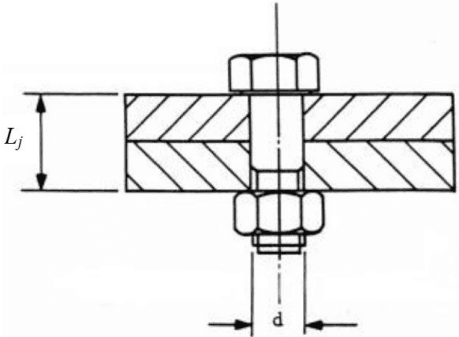
Figure description:
Entities:
- Fastener: Hexagonal head bolt with a corresponding nut.
- Clamped Parts: Two cross-hatched plates secured together.
Visible Data:
- : Dimension indicating the total thickness of the clamped parts (grip length.
- : Dimension indicating the diameter of the fastener shank.
- Centerline: Vertical dashed-dotted line through the axis of the fastener.
Figure 7-1 - Typical Joint Components
which leads to a simple relation between the elongations of the fastener and clamped parts,