16.4.1 Variation of Yield Stress with Temperature
The influence of temperature on the yield stress of steel shall be taken as follows for structures of mild steels and high strength low alloy steels:
where
yield stress of steel at
- yield stress of steel at (room temperature), and
temperature of the steel in .
This relationship is shown by Curve 1 in Fig. 24.
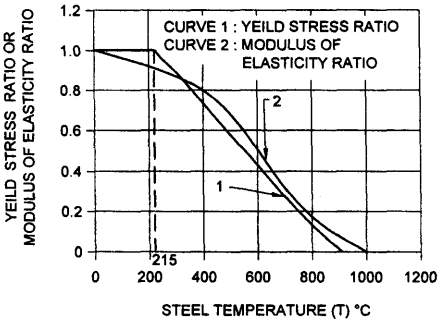
Figure description:
Yield Stress and Modulus of Elasticity Ratios for Steel at Elevated Temperatures
YEILD STRESS RATIO OR MODULUS OF ELASTICITY RATIO VS STEEL TEMPERATURE (T °C
Legend
- CURVE 1 : YEILD STRESS RATIO — color: black; symbol: solid line
- CURVE 2 : MODULUS OF ELASTICITY RATIO — color: black; symbol: solid line
Annotations
- 215 (text_label - position: x = 215)
- T = 215 transition for Curve 1 (vertical_line - position: x = 215)
| STEEL TEMPERATURE (T °C) | YEILD STRESS RATIO (CURVE 1) | MODULUS OF ELASTICITY RATIO (CURVE 2) |
|---|---|---|
| 0 | 1.0 | 1.0 |
| 200 | 1.0 | 0.9 |
| 215 | 1.0 | 0.89 |
| 400 | 0.8 | 0.8 |
| 600 | 0.47 | 0.55 |
| 800 | 0.11 | 0.2 |
| 900 | 0.0 | 0.1 |
| 1000 | null | 0.0 |
Notes: Note the misspelling of 'YIELD' as 'YEILD' in the source graph. Curve 1 remains constant at 1.0 until 215°C, while Curve 2 begins to decrease immediately from 0°C. Both curves intersect at a ratio of 0.8 at 400°C.
FIG. 24 VARIATION OF MECHANICAL PROPERTIES OF STEEL WITH TEMPERATURE
For temperature less than 215°C no reduction in the yield stress need to be considered.
16.4.2 Variation of Modulus of Elasticity with Temperature
The influence of temperature on the modulus of elasticity shall be taken as follows for structures of mild steels and high strength low alloy steels:
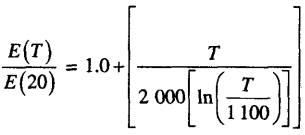
when
when
This relationship is shown by curve 2 in Fig. 24.
16.4.3
For special steel with higher temperature resistance, such as TMCP steels, the manufacturer's recommendation shall be used to obtain the variation of yield strength and modulus of elasticity of steel with temperature.