Unless otherwise noted in the contract documents, the fabricator is permitted to order the materials that are necessary for fabrication when the fabricator receives contract documents that have been released for construction.
Commentary
The fabricator may purchase materials in stock lengths, exact lengths, or multiples of exact lengths to suit the dimensions shown in the structural design documents. Such purchases will normally be job-specific in nature and may not be suitable for use on other projects or returned for full credit if subsequent design changes make these materials unsuitable for their originally intended use. The fabricator should be paid for these materials upon delivery from the mill, subject to appropriate additional payment or credit if subsequent unanticipated modification or reorder is required. Purchasing materials to exact lengths is not considered fabrication.
5.1.1
Unless otherwise specified by means of special testing requirements in the contract documents, mill testing shall be limited to those tests that are required for the material in the ASTM specifications indicated in the contract documents. Materials shall be marked by the supplier as specified in applicable ASTM standard specifications prior to delivery to the fabricator's shop or other point of use. Such material not so marked by the supplier, shall not be used until
- (a) Its identification is established by means of testing in accordance with the applicable ASTM specifications
- (b) A fabricator's identification mark, as described in Section 6.1 has been applied
5.1.2
When mill material does not satisfy applicable ASTM tolerances for camber, profile, flatness, or sweep, the fabricator is permitted to perform corrective procedures, including the use of controlled heating and/or mechanical straightening, subject to the limitations in ANSI/AISC 360.
Commentary
Dimensional tolerances for rolled mill material are set forth in ASTM A6/ A6M. Likewise, dimensional tolerances for HSS and pipe material are set forth in the applicable ASTM standard specifications. Normal variations in the cross-sectional geometry of standard structural shapes must be recognized by the designer, the fabricator, the steel detailer, and the erector (for example, see Figure C-5.1). Such tolerances are mandatory because roll wear—thermal distortions of the hot cross section immediately after leaving the forming rolls and differential cooling distortions that take place on the cooling beds—are all unavoidable. Geometric perfection of the cross section is not necessary for either structural or architectural reasons if the tolerances are recognized and provided for.
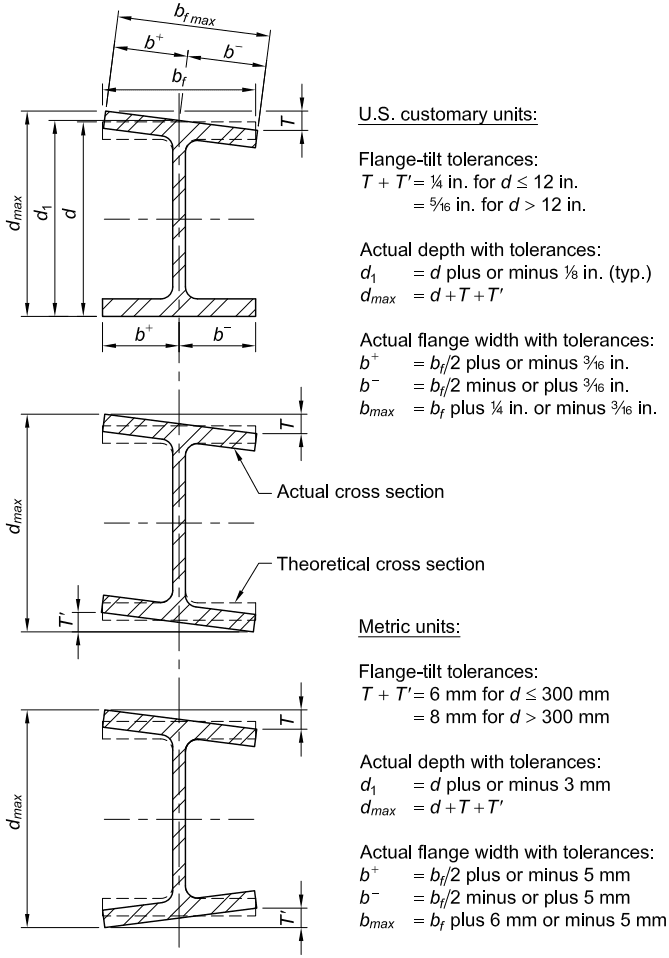
Figure description:
Subject: Mill tolerances for the cross section of a W-shape steel beam, comparing theoretical vs. actual cross sections.
Key Dimensions Defined:
- : Theoretical depth
- : Actual depth
- : Total depth including flange tilt (
- : Theoretical flange width
- : Flange width segments from the centerline
- : Flange tilt measurements
U.S. Customary Units Tolerances:
- Flange-tilt (: 1/4 in. for in.; 5/16 in. for in.
- Actual depth (: in.
- Actual flange width:
- in.
- in.
- in. or in.
Metric Units Tolerances:
- Flange-tilt (: 6 mm for mm; 8 mm for mm.
- Actual depth (: mm.
- Actual flange width:
- mm
- mm
- mm or mm
Fig. C-5.1. Mill tolerances on the cross section of a W-shape.
ASTM standard specifications also stipulate tolerances for straightness that are adequate for typical construction. However, these characteristics may be controlled or corrected to closer tolerances during the fabrication process when the added cost is justified by the special requirements for an atypical project.
5.1.3
When variations that exceed ASTM A6/A6M tolerances are discovered or occur after the receipt of mill material, the fabricator shall, at the fabricator's option, be permitted to perform the ASTM A6/A6M corrective procedures for mill reconditioning of the surface of structural steel shapes and plates.
5.1.4
When special tolerances that are more restrictive than those in the applicable ASTM standard specifications are required for mill materials, such special tolerances shall be specified in the contract documents. The fabricator shall, at the fabricator's option, be permitted to order material to the applicable ASTM standard specifications tolerances and subsequently perform the corrective procedures described in Sections 5.1.2 and 5.1.3.