Requirements in this section may already be covered as part of a broader set of design requirements levied on the program. It is highly recommended that the requirements in this section be reviewed for duplication against existing program requirements. In cases where there is duplication, it is recommended to apply tailoring to this NASA Technical Standard and not apply some or all of the requirements of this section.
4.7.1 Materials
[TFSR 20] Materials used in threaded fastening systems shall comply with NASA-STD-6016, Standard Materials and Processes Requirements for Spacecraft.
[Rationale: Material issues of particular importance for threaded fastening systems include galling, corrosion, stress-corrosion cracking, hydrogen embrittlement, creep, outgassing, and effects of atomic oxygen. These issues and others are addressed in NASA-STD-6016.]
4.7.2 Thread Form Compatibility
[TFSR 21] Mating threaded parts shall have compatible thread forms.
[Rationale: Using incompatible thread forms can result in dimensional interference and may lead to seizure, inadequate strength, inadequate preload for a specified torque value, or inability to disassemble.]
Examples of incompatible thread combinations are:
- Fine threads mated to coarse threads, or
- Inch-based threads mated to metric threads, or
- Mated threads with the same pitch and different nominal diameters, or
- External UNJ threads mated to UN internal threads, or
- External MJ threads mated to M internal threads.
4.7.3 Use of Washers and Chamfered Bolt Holes
[TFSR 22] Clearance shall be provided for the head-to-shank fillet radius as needed to avoid interference with the clamped parts through the use of chamfered holes or countersunk washers installed under bolt heads with the countersink facing the bolt head (see Figure 2, Dimensional Considerations in Selecting Fastening Hardware.)
[Rationale: Interferences between mating components can lead to unreliable preload, reduced strength, or inadequate performance against separation of a nominally designed fastening system.]
Flush-head screws should be installed without washers under the head.
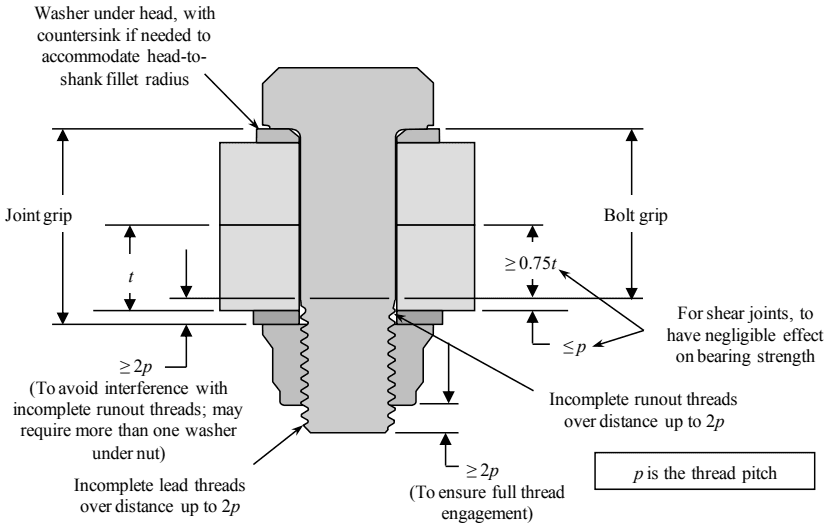
Figure description:
- Washer under head: Used with countersink if needed for head-to-shank fillet radius.
- Joint grip: Measurement from the top washer to the bottom washer.
- Bolt grip: Measurement from the bolt head to the start of the threads.
- Distance (under nut: To avoid interference with incomplete runout threads; may require multiple washers.
- Distance : Dimension between the bottom of the clamped part and the start of full threads.
- Distance : Dimension for shear joints to have negligible effect on bearing strength.
- Distance (at end of bolt: To ensure full thread engagement.
- Incomplete runout threads: Located over a distance up to near the shank.
- Incomplete lead threads: Located over a distance up to at the bolt tip.
- Key entities: Bolt, nut, washers, clamped parts (thickness .
- Legend: is the thread pitch.
4.7.4 Fastener Length Selection for Thread Engagement
[TFSR 23] When the threaded fastening system incorporates a prevailing torque locking feature, the fastener length shall be sufficient for fully formed threads to engage the locking feature.
[Rationale: The location of the locking feature is not consistent across all designs; so when a prevailing torque locking feature is used as a control to satisfy the requirement for a preload independent locking feature, the fastener length should be sufficient to fully engage the feature.]
To ensure that all internal threads are fully engaged, the length of each fastener used with a nut, nut plate, or insert should be selected to extend a distance of at least twice the thread pitch, p,
past the outboard end of the nut, nut plate, or insert. Figure 2 points out common methods of addressing dimensional issues in hardware selection for a fastener used with a nut.
To avoid thread stripping as the critical failure mode, thread engagement in an internally threaded part other than a nut, nut plate, or insert should be selected to ensure the minimum number of engaged complete threads such that the fastener would fail in tension before threads would strip. It is desirable to have the fastener fail in tension before the threads strip to facilitate ease of repair and to increase the likelihood that any failed hardware may be detected. In addition, fastener tensile failures typically exhibit more plastic deformation prior to rupture, allowing loads to redistribute between fasteners before failure occurs in any one threaded fastening system.
4.7.5 Bolt Grip Selection to Prevent Interference
- a. [TFSR 24] For a fastener with a full diameter body, the bolt grip and the number and type of washers shall be selected to ensure the internal threads do not encroach on the incomplete runout threads of the fastener. [Rationale: Inadequate bolt grip can lead to engaging the incomplete runout threads, thereby introducing uncertainty in the preload.] Where complete threads transition to the unthreaded full diameter body, incomplete runout threads exist over a distance up to twice the pitch on most commercial aerospace fasteners. If the nut or the insert engages the incomplete runout threads, interference may occur and the intended preload may not be achieved.
- b. [TFSR 25] Fasteners threaded into blind holes shall be selected to prevent contacting the bottom of the hole or interfering with incomplete internal threads.
[Rationale: Improper bolt grip selection that leads to interferences can lead to unpredicted performance of as-installed fasteners.]
Where blind holes are tapped, incomplete internal threads are present at the bottom of the hole.