[FCR 5] All parts used in human-rated spaceflight hardware shall be evaluated to identify the following:
- a. The fracture control classification of each part as either exempt, NFC, or fracture critical.
- b. The corresponding approaches that follow the requirements of this NASA Technical Standard to be documented in the FCP.
[Rationale: To implement fracture control, all parts need to be evaluated for criticality to assure they are appropriately classified and to identify subsequent activities related to the classification. Not all parts are fracture critical.]
The approach implemented for fracture control classification of parts is documented in the FCP as described in section 4.1 [FCR 1].
All parts go through a fracture control classification process for all mission phases to determine which parts are fracture critical. Parts may be classified as one of the following:
- a. Exempt.
- b. NFC.
- c. Fracture critical.
Parts classified as exempt are to be exempt for all phases of the service life of the part. Parts that are fracture critical in any phase of the service life of the part are classified as fracture critical. Parts that do not fit into the exempt or NFC categories are to be classified and evaluated as fracture critical parts.
Approaches to evaluate hardware in these three categories are presented in sections 5, 6, and 7 in this NASA Technical Standard. Figure 2, NASA-STD-5019A Fracture Control Classification Logic Diagram, shows a logic diagram for the classification of parts and references to the applicable sections of this document. Figure 3, Fracture Control Assessment Process and Activities Corresponding to Parts Classifications, is a chart with a general description of activities associated with each classification. If hardware that was certified to earlier fracture control requirements levied under earlier programs is to be flown under a new program, then the hardware should be re-assessed using the fracture control requirements of this document. Additionally, hardware that experiences service life conditions that deviate from the certified design configuration or conditions, either
NASA-STD-5019A w/CHANGE 4
through off-nominal service conditions or degradation during service, is to be re-assessed in accordance with the requirements of this document.
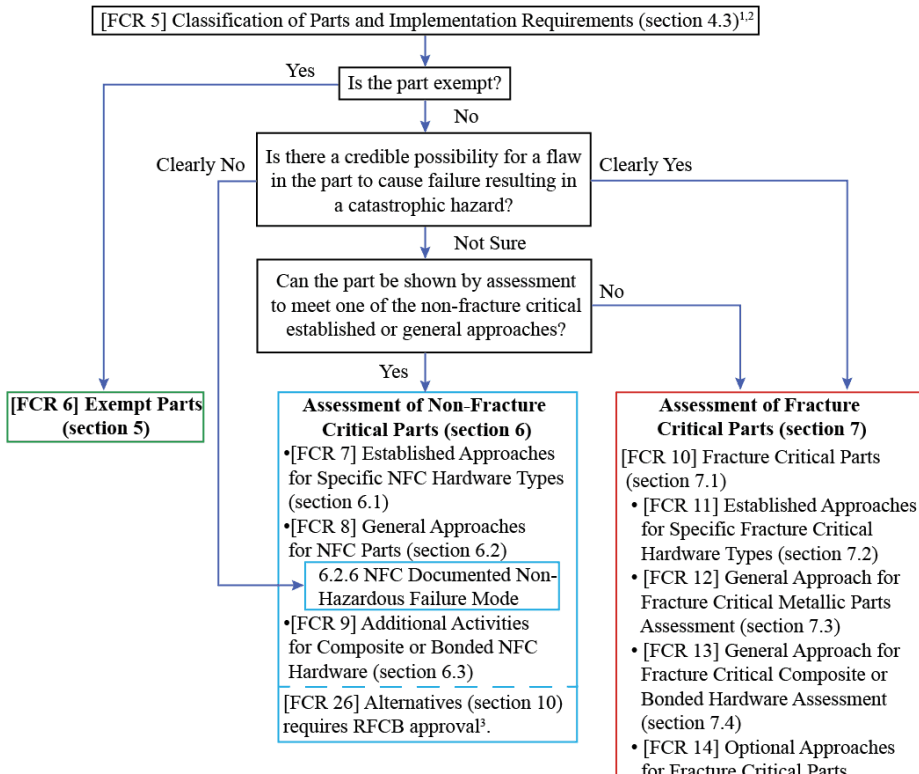
Figure description:
Flowchart: Classification of Parts and Implementation Requirements (FCR 5
Decision Steps:
- Is the part exempt?
- Yes: Proceed to [FCR 6 Exempt Parts (section 5.
- No: Proceed to next question.
- Is there a credible possibility for a flaw to cause a catastrophic hazard?
- Clearly No: Proceed to 6.2.6 NFC Documented Non-Hazardous Failure Mode.
- Clearly Yes: Proceed to Assessment of Fracture Critical Parts (section 7.
- Not Sure: Proceed to next question.
- Can assessment show the part meets non-fracture critical established or general approaches?
- Yes: Proceed to Assessment of Non-Fracture Critical Parts (section 6.
- No: Proceed to Assessment of Fracture Critical Parts (section 7.
Outcome Pathways:
- Assessment of Non-Fracture Critical Parts (Section 6:
- [FCR 7 Established Approaches for Specific NFC Hardware Types (section 6.1
- [FCR 8 General Approaches for NFC Parts (section 6.2
- 6.2.6 NFC Documented Non-Hazardous Failure Mode
- [FCR 9 Additional Activities for Composite or Bonded NFC Hardware (section 6.3
- [FCR 26 Alternatives (section 10 requires RFCB approval.
- Assessment of Fracture Critical Parts (Section 7:
- [FCR 10 Fracture Critical Parts (section 7.1
- [FCR 11 Established Approaches for Specific Fracture Critical Hardware Types (section 7.2
- [FCR 12 General Approach for Fracture Critical Metallic Parts Assessment (section 7.3
- [FCR 13 General Approach for Fracture Critical Composite or Bonded Hardware Assessment (section 7.4
- [FCR 14 Optional Approaches for Fracture Critical Parts (section 7.5
- • [FCR 14] Optional Approaches for Fracture Critical Parts (section 7.5)
[FCR 26] Alternatives (section 10) requires RFCB approval³.
Notes
- Each part is demonstrated to satisfy the selected classification by a process with documentation cited in the Fracture Control Summary Report.
- A part may always be classified as fracture critical if there is doubt or concern related to demonstrating that it is NFC or exempt.
- An alternative approach to any classification or category may be developed and presented with rationale to the RFCB for approval in accordance with section 10 in this Standard.
NASA-STD-5019A w/CHANGE 4
Figure 2—NASA-STD-5019A Fracture Control Classification Logic Diagram
| Legend:.1 | |
|---|---|
| NDE | non-destructive evaluation |
| NFC | non-fracture critical |
| RFCB | Responsible Fracture Control Board |
Required* Actions: [FCR 6] Exempt Parts (section 5)=No additional action beyond the FCP and FCSR documentation, Non-Fracture Critical Parts (section 6)=Various, including analysis, test, inspection, and verification., [FCR 10] Fracture Critical Parts (section 7)=•Damage Tolerance Analysis/Test •Flaw Screening •Traceability •Material Selection •Verification Required* Actions: [FCR 6] Exempt Parts (section 5)=No additional action beyond the FCP and FCSR documentation, Non-Fracture Critical Parts (section 6)=Unique to NFC Composite or Bonded: •Damage Threat Assessment •Impact Damage Mitigation Plan •Residual Threat Determination •Flaw Screening with NDE •Material Selection •Traceability, [FCR 10] Fracture Critical Parts (section 7)=Unique to Composite or Bonded: •Damage Threat Assessment •Impact Damage Mitigation Plan •Residual Threat Determination •Building Block Test and Analysis *Note: Documentation is required for all classifications [FCR 1]. In addition to these unique actions, documentation of the approach used to demonstrate that each part satisfies the selected classification is to be cited in the Fracture Control Summary Report [FCR 24].
Legend: FCP: Fracture Control Plan FCSR: Fracture Control Summary Report NDE: non-destructive evaluation NFC: non-fracture critical RFCB: Responsible Fracture Control Board
| [FCR 6] Exempt Parts (section 5) | Non-Fracture Critical Parts (section 6) | [FCR 10] Fracture Critical Parts (section 7) | |
|---|---|---|---|
| Approach | Parts fit in one of the following: | Assessment of NFC Parts (section 6) | Assessment of Fracture Critical Parts (section 7) |
| Approach | •[FCR 6] a. Non-structural parts with no credible failure mode caused by a flaw •[FCR 6] b. Non-structural parts with no credible potential for causing a catastrophic hazard •[FCR 6] c. Other non-structural parts approved by the RFCB for exempt status | •[FCR 7] Established Approaches for Specific NFC Hardware Types (section 6.1) •[FCR 8] General Approaches for NFC Parts (section 6.2) •[FCR 9] Additional Activities for Composite or Bonded NFC Hardware (section 6.3) | •[FCR 10] Fracture Critical Parts (section 7.1) •[FCR 11] Established Approaches for Specific Fracture Critical Hardware Types (section 7.2) •[FCR 12] General Approach for Fracture Critical Metallic Parts Assessment (section 7.3) •[FCR 13] General Approach for Fracture Critical Composite or Bonded Hardware Assessment (section 7.4) •[FCR 14] Optional Approaches for Fracture Critical Parts (section 7.5) |
| Approach | [FCR 26] Alternatives (section 10) requires RFCB approval. | [FCR 26] Alternatives (section 10) requires RFCB approval. | |
| Required* Actions | No additional action beyond the FCP and FCSR documentation | Various, including analysis, test, inspection, and verification. | •Damage Tolerance Analysis/Test •Flaw Screening •Traceability •Material Selection •Verification |
| Required* Actions | No additional action beyond the FCP and FCSR documentation | Unique to NFC Composite or Bonded: •Damage Threat Assessment •Impact Damage Mitigation Plan •Residual Threat Determination •Flaw Screening with NDE •Material Selection •Traceability | Unique to Composite or Bonded: •Damage Threat Assessment •Impact Damage Mitigation Plan •Residual Threat Determination •Building Block Test and Analysis |
NASA-STD-5019A w/CHANGE 4
Figure 3—Fracture Control Assessment Process and Activities Corresponding to Parts Classifications
Controlled by: NASA